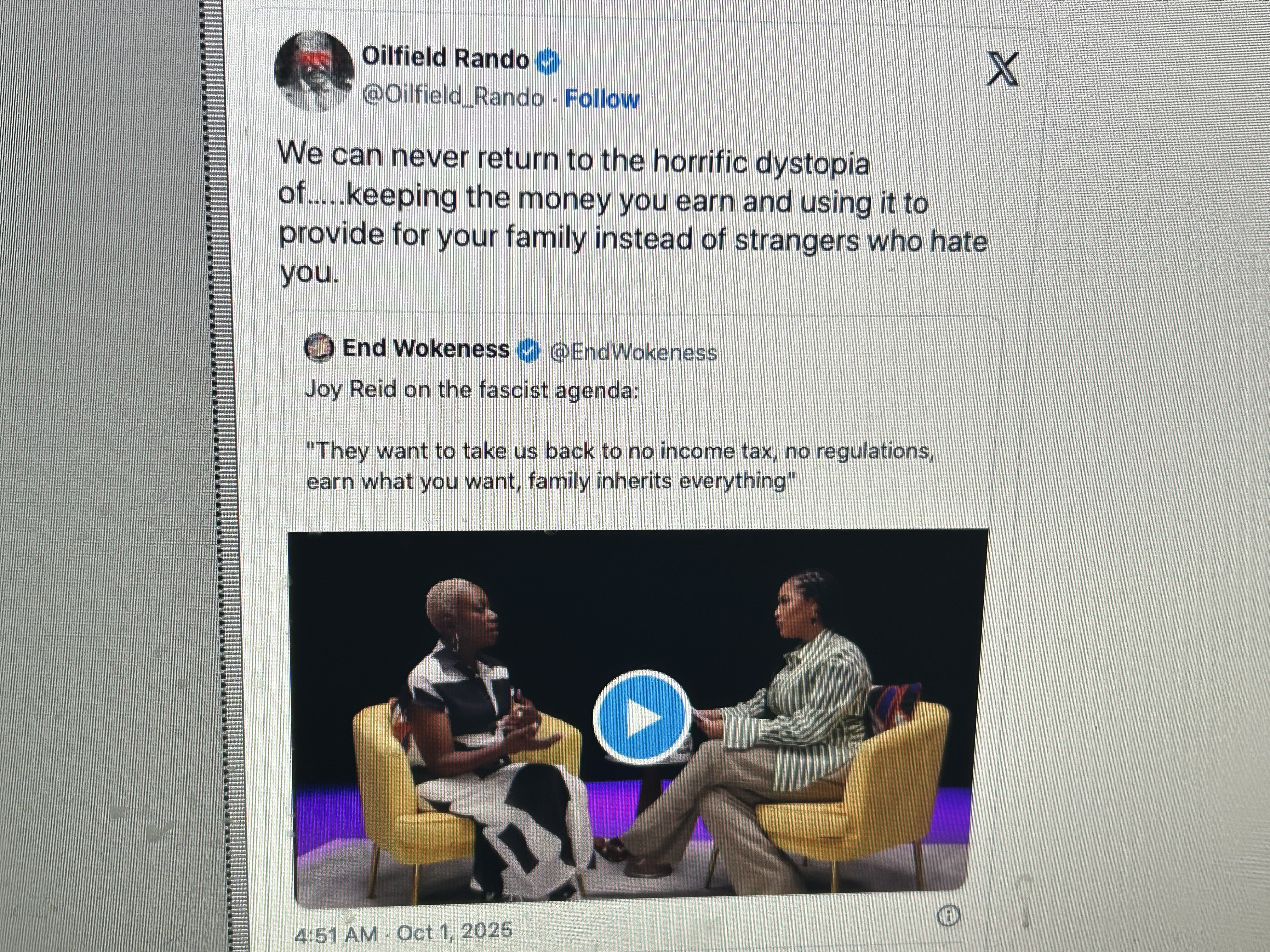
I am amazed when I see posts like the one above. People who want to do away with taxes and regulations have this idea that once they are free from taxes and regulation that they will have all this extra money to spend and lead a glorious government free life. Unfortunately the tax free, regulation free past was miserable. It is only with the expansion of government which regulated the market economy and the taxes paid by the public for these changes did this general misery end.

Once you remove taxation and regulation, people will be presented with an array of new bills which have to be paid. Things like nuclear weapons, the army, the navy, the air force, the justice system, police protection, fire protection, road repair, street lights — all these things and so much more will need to be paid for. Then people will have to figure out if their restaurants meet health standards, buildings are being built so that they will stay up during earthquakes, stopping people from dumping toxins into rivers, checking to see if every household is disposing of human waste properly, to name just a few. Who will do it? How will they be paid?

Is Government perfect? Absolutely not. Could it be done better? Of course. Is this a reason to do away with it completely. No. No more than a Market Economy can’t do everything to meet all of our needs, at least, not without the help of government.

Here is the bottom line — the vast majority of people in this country want a market economy. This isn’t going to change in the near future. In order to make this market economy work, we also need a strong government presence to ensure that the rich, people who have power and money, don’t abuse this power and money to take advantage of people who do not have power and money. This also isn’t going to change in the near future.

This means that we have to figure out a way to make these two, sometimes, antagonistic systems work together. Is this perfect? No but then no system is perfect. Ever. This is our common challenge — how to make an imperfect world work for as many people as humanly possible. It will always be imperfect and we will always be working to make it better. But, given the present interlocking structures that is our system, eliminating Government is absurd and unworkable.

I managed people who held low level jobs and limited opportunities for advancement. They are, by and large, an unmotivated bunch. They did their work adequately and left on time. They weren’t there for more than a paycheck. Good for them, I say.

One of the things my managers frequently tasked me with is how to motivate these people. And before I could say more money they then added the painful restriction without offering them more money. More money was always the hitch. The companies wanted to motivate the employees without paying them more. Needless to say, nothing we ever came up with worked.

The problem here is that the highly compensated people who run companies have convinced themselves that more money only works to motivate high level people. Low level people want something else. I attended seminars where I was told countless times that employees actually want other things than more money. They want respect. They want autonomy. They want acknowledgment. Notice that all of these things are free for the company. They are also vague and difficult to deliver for the direct managers. How much autonomy can you give to a person who has a highly structured job with expectations of coming in on budget and on time? If you didn’t deliver, you were encouraged to do better; if you did well, you got a pat on the back.

The budget for employee incentives were such that it was easiest to reward the group instead of the individual. So Donut Fridays and elegant Christmas parties were thought of enticements which never delivered the expected punch. I actually had one employee ask if instead of going to the Christmas party could she instead have the percentage we paid on a per person catering charge in cash. She would rather have the 29.99 than spend time at the party. I had to explain to her that this was a group incentive and her choice was the party or nothing. She, obviously, was being facetious but her point was made — the company was giving her something she didn’t want.

Even more ironical is that when I relayed this information to my boss, she completely understood. This to me, speaks volumes, about corporate culture — everybody knows this won’t work, but since we can’t give more money individually we are stuck we these group benefits that nobody cares about and won’t deliver. In other words, everyone knows these actions are doomed to failure from the start but continue doing them because nobody has a better idea.

I worked for a company that diligently surveyed their employees on how they felt about work. A neutral company took the survey, the results tallied and delivered to the employees. Every year the areas where my department scored lowest would be our focus to improve for the next survey. Except, of course, low pay. Everyone knew we couldn’t change that so low pay was a problem when the first survey was taken and low pay was a problem on the last survey I was there for. I am betting, with almost 100 % chance that I am right and after being away for six years, low pay is still one of the lowest scoring areas for my department.

The higher ups, convinced by seminars they attended where they were told that higher pay is not the major concern for employees, made us middle managers attend these same seminars so that we too can understand that higher pay was not the reason people worked. We learned how to encourage employees, how to discipline employees, how to reward them without giving them any money and, of course, nobody was convinced.

What is so baffling to me is this resistance to giving more money when the higher ups know the way to get people to work harder is to give them more money. This is, after all, the argument for giving rich people more money. We want them to work hard right? These people are the innovators, the entrepreneurs, and the risk takers. They have to be rewarded. If you take away their money, they won’t work very hard. But if you give them money — will the sky is the limit.

Exactly. So why should regular employees be treated differently? It is a blindness to the very economic tenets that Business so enthusiastically embraces. But by all means, continue with the Pizza Parties and Donut Fridays. I am sure one day that it will eventually work.

One of the enduring mysteries of American Tax laws is why do the Rich need so much help.

Let me start with tax laws because this is where the Rich do their best to milk the rest of us. A tax bill is money owed the government for services provided. Now you may not like to pay taxes (who does?) but the political institutions that guide our communal living has determined this is the money a person owes. Citizens have an opportunity to change these laws by electing people of a similar mind in the frequent elections held in this country.

It is the price for living here in the USA — the greatest country on the face of the earth, right? But the Rich are constantly complaining that they need more money in order to juice the economy and if you give them more money it will actually help everyone else because the Rich will be spending money on their businesses. So since the election of Reagan in 1980, taxes have been routinely cut and tax breaks have been instituted to such a degree that many rich people and companies presently pay absolutely no income taxes.

How is this working for everyone else? Have the rich fulfilled their promise to make the rest of us rich with their selfless spending. Surely the Americans must have the richest poor people on the face of the earth. They must be swimming in luxury — great health care, cheap housing, good public education.

But this isn’t the story. Why hasn’t all this largess to the Rich had any effect? Hmm. Let me think about this. Perhaps they haven’t been juicing the American economy. How could this be? They claim to love this country so much, why hasn’t all this love and money translated into a more stable economic situation for everyone else. What could be wrong?

The Rich do have an answer. They just need even more tax cuts. They just haven’t been given enough money to juice the economy. This means everyone else will have to suck it up when cutting government funded programs for the poor and the middle class. The American taxpayer simply can’t afford to help everyone and it is vital that the Rich get even more money then, and only then, will the rich have enough money to spend the rest of us into prosperity.

Let’s try a little thought experiment. What if, instead of giving money to the rich, we gave it to poor and the middle class. They will buy groceries, cars, air conditioners, and a whole array of products that, you got it, will juice the economy. In fact, because there are more just plain folk than there are rich people, it might just juice the economy better and faster than giving money to the rich. I don’t know but I would like to give it a try. Giving to the rich hasn’t exactly worked as promised.

But the budget. We haven’t collected enough in taxes to pay for all this help. Right. Because we are giving the Rich so much back in tax reduction, we are going into debt and unable to afford actions that might help everyone else. Get out your handkerchiefs. Why is it that the only time the Republicans care about the budget deficit is when it involves expanding programs that help the poor. They don’t give a damn about the budget deficits when they are cutting taxes for the Rich which has exactly the same effect — budget deficits.

The whole premise of helping the rich in order to help the poor is so demented. It is a topsy turvy Alice through the looking glass view of living. Our most economically secure citizens — the people with the most money, the best healthcare, luxury vacations, personal airplanes and such — always need our help while we can’t help our least economically secure citizens who don’t have money, or healthcare, or even a safe place to lay their head at night. Helping the poor is always seen as bad while helping the rich is necessary. How does this make sense?

That this story keeps being told, with a straight face no less, is depressing. Years of low taxation and cuts in social services have shown, it to be patently false. But hey ho, I’ve got mine.

Until I don’t.

I had numerous misgivings about Bryan Caplan’s It’s Not Who You Know, It’s Who You Are. Caplan’s bottom line is that there is no advantage to being rich in a capitalist society. The cream always rises to the top and it is because the rich have better genes than the poor and middle class and this is why they always rise to the top.

How did he determine this? Did he give a bunch of poor kids a million dollar trust fund, a financial advisor and entrance into all the best private schools and then compare it to the rich kids who had this advantage already? Or did he force rich kids into resource stretched public schools, make them work three jobs just to meet rent, and made it impossible to talk to Daddy during the length of the study? A little more information is needed here in order for me to buy the bull shit Caplan is selling.

If he is just looking at where people ended up, then he failed to prove his point. Are you telling me that knowing other rich people isn’t helpful to rich kids looking for jobs? Almost every job I have ever gotten was because I knew someone in the company. I knew a job was available and I knew who to talk to in order to be seen. Being seen is half the battle in getting a job. This is a tremendous advantage over someone who knows no one. How does he factor that in to his analysis?

Why would rich people spend upwards to $100,00 a year for private education if this doesn’t give their child some advantage? If their child got the same education in a local public school, they would be a fool not to — it comes with their taxes. Yet these rich people, and Caplan believes smarter people, still spend a lot of money on a private education for their genetically superior kids. There can only be one explanation — expensive private schools make a difference. They are worth the money. If, of course, you have it.

Finally, I thought one of the assumptions of market capitalism is that poor people have to learn to work hard in order to pull themselves up by their own bootstraps. Anyone can make it to the top if they work hard, they too can become rich. But if they are too genetically inferior to make it happen, why needlessly raise their hopes if they are going to end up being poor no matter how hard they work. How sadistic is that.

Genetic superiority is a pernicious and dangerous lie. When people believe they are superior, it opens them up to differentiate between human beings. There are better people who deserve more. To diminish the value of money is equally dangerous. Why have public schools and Head Start if the kids are hopeless. You can’t spend enough money on rich kids and no amount of money will change the results for poor kids. Why waste time and money on lost causes? Nothing personal here. It is all genetic.

Since Trump’s election, I continue to be puzzled by the passivity of the Billionaires Boy’s Club. The system, though imperfect and could be a lot better, has worked reasonably well for a broad swath of the American people particularly the wealthy. The very same men who explicitly or tacitly support Trump’s rampage against the Federal Government are attacking the system that made them rich.

What more can these people at the very top of the heap want? Despite their frequent complaints to the contrary, the American people, and the rich in particular, are taxed very little. These billionaires act as if the government has actually hobbled their chances on obtaining wealth. Musk has in the neighborhood of 244 billion dollars. Bezos has 197 billion. You can see the whole list here. They are billionaires for Christ’s Sake. What has government deprived them of? A 15% Federal tax bill?

Also, notice how Musk and his DOGE buddies are only going after programs that help the poor and the Middle Class — Social Security, Medicaid, Medicare — while remaining silent about tax breaks for billionaires. Tax breaks, which almost exclusively benefit the wealthy with no expectation that the money they save from eliminated taxes are reinvested into industry, are good. While government programs that help the poor and the middle class are bad. Helping people only encourages dependence on the Federal Government.

So, the already wealthy are demanding even more sacrifices from the less wealthy in order that the already wealthy can make even more money so that they will, hopefully, reinvest this money into the economy. Why are the already wealthy so dependent on the Federal Government for investment money? Of course, few people phrase the question that way.

More troubling is that there is no credible plan on how to replace this functioning system other than the economy will be so good that there will be no need for the federal government. I find it a little difficult to believe that the homeless will be shocked so profoundly by these new limitations that they will suddenly become employable. I, for one, would like a little more detail. What happens to the poor? What happens when Social Security is gone? How does this support better public education? How will healthcare became more accessible? Nothing but silence.

These people, who have benefited most from the present system, are just hoping that their immense wealth will protect them from the fallout of this chainsawing frenzy. The rich no longer have the idea of noblesse oblige that, because they have benefited from the system, they also have an obligation to help other people. They will watch the carnage from a safe distance. At least this is what they hope.

Burn it all down. None of it is any good anymore. We will figure out how to rebuild later. The old Viet Nam war adage applies here — we had to burn the village in order to save it.

Thanks for nothing.

I had another point I wanted to make in my blog about Free Checking and I realized that I forgot to say it.

Marianne Lake, the evil genius who runs Chase Bank, explained that the elimination of free checking was due to the government cracking down on banks for their late and overdraft fees. She also warned that the end of free checking was going to have the biggest impact on the people who can least afford it.

This is the standard business reaction to anything government does to help regular people. It is actually bad for regular people because business will just find some way around it. You see, Business is trying to do the right thing but Government is forcing their hand. Government is making us hurt regular people because they want to regulate the way business treats regular people. In other words, since Government is preventing banks from screwing regular people one way, banks will just find another way to screw them and it’s all Government’s fault. Lake’s concern for regular people is underwhelming.

Furthermore, who exactly does she think is paying the exorbitant late and overdraft fees now? Billionaires? Vulnerable people are already being taken advantage by her bank just in a different way. Doing away with Free Checking is just another new way to take advantage of them.

So fuck you Marianne Lake and your phony concern for vulnerable customers.

Marianne Lake, who runs Chase Bank, announced that Free Checking is going to end for that bank and she anticipates the other big banks will follow.

I only stay with the big banks for 2 reasons — Free Checking and Free ATM’s. If this ends I see no reason to stay with the big banks. They are completely useless to me as a normal business customer because every time I use my ATM, I am taking money out of my checking account. I am guessing that means if I use an ATM, I will be charged for writing a check. This ends Free Checking and Free ATM in one fell swoop.

The big banks are useless especially to those of us on the more modest side of the pay scale. I tried getting a saving’s accounts at a big bank. It cost more money to have the account than I received in interest. CD’s are better in the sense that I don’t lose any money but when I close out my last CD with a big bank I was getting in the neighborhood of .50 cents. You heard me right — .50 cents.

The sad part of this whole thing is my leaving will not be a problem for my big bank. In fact, a clerk accidentally spilled the beans with me one day when I was trying to find the best place for my $5,000. The answer was loud and clear. I just didn’t have enough money for the bank to bother with my accounts.