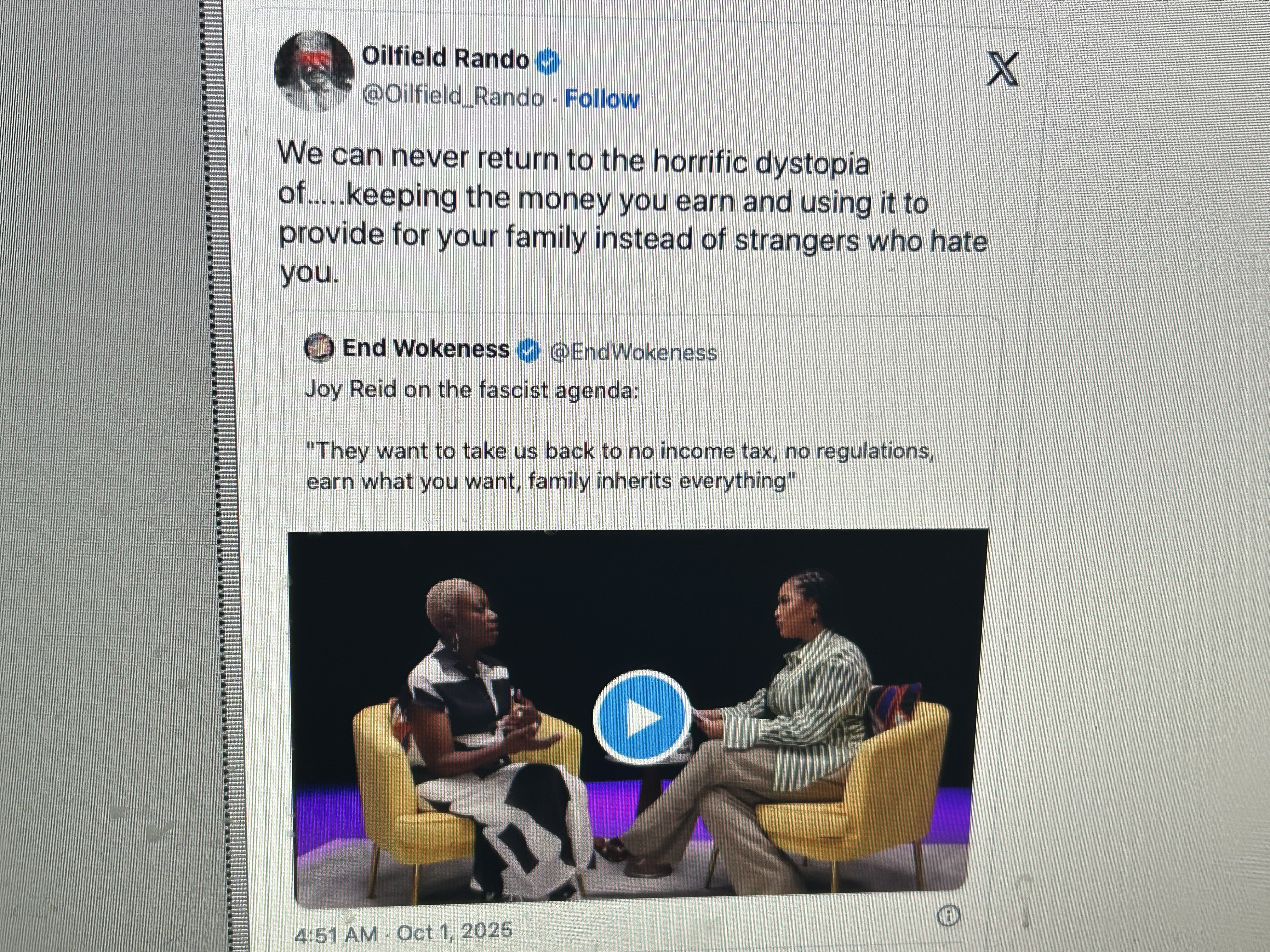
One of the most remarkable accomplishments of modern marketing is the one the Rich have pulled on the American Middle Class. They have managed to make Americans more afraid of taxing wealthy people in the unlikely event that these members of the Middle Class become billionaires than the much more likely event that they will need, at some point in their life, available social services that will help them weather a financial storm.

It is peculiarly American trait which turns its full power against the Poor for being poor and fuels fear in the Middle Class that if they tax too much the whole money machine we have come to depend upon will come crashing down around them and, then, everybody will be poor. Is that what you want? Everyone being poor. How this message continues to attract believers is beyond me but lets face it, it somehow continues to hold a large segment of the American population in it’s thrall.

I am amazed when I see posts like the one above. People who want to do away with taxes and regulations have this idea that once they are free from taxes and regulation that they will have all this extra money to spend and lead a glorious government free life. Unfortunately the tax free, regulation free past was miserable. It is only with the expansion of government which regulated the market economy and the taxes paid by the public for these changes did this general misery end.

Once you remove taxation and regulation, people will be presented with an array of new bills which have to be paid. Things like nuclear weapons, the army, the navy, the air force, the justice system, police protection, fire protection, road repair, street lights — all these things and so much more will need to be paid for. Then people will have to figure out if their restaurants meet health standards, buildings are being built so that they will stay up during earthquakes, stopping people from dumping toxins into rivers, checking to see if every household is disposing of human waste properly, to name just a few. Who will do it? How will they be paid?

Is Government perfect? Absolutely not. Could it be done better? Of course. Is this a reason to do away with it completely. No. No more than a Market Economy can’t do everything to meet all of our needs, at least, not without the help of government.

Here is the bottom line — the vast majority of people in this country want a market economy. This isn’t going to change in the near future. In order to make this market economy work, we also need a strong government presence to ensure that the rich, people who have power and money, don’t abuse this power and money to take advantage of people who do not have power and money. This also isn’t going to change in the near future.

This means that we have to figure out a way to make these two, sometimes, antagonistic systems work together. Is this perfect? No but then no system is perfect. Ever. This is our common challenge — how to make an imperfect world work for as many people as humanly possible. It will always be imperfect and we will always be working to make it better. But, given the present interlocking structures that is our system, eliminating Government is absurd and unworkable.

I try not to read too much news as I find it depressing and unhelpful. I am sorry but there is only so much time I am willing to give to Donald Trump’s shenanigans. There has to be more life than complaining about him so I was struck by a friend’s post in Facebook about Trump. I missed it and it was indeed shocking. Tim Cook, the CEO of Apple, prostrated himself before Donald Trump in order to ensure that his company is exempt from Trump’s tariffs.

This isn’t the way government is supposed to work. Trump’s whole theory behind the tariffs is that he wants to bring back jobs to American workers. Yet, Cook, a large company with a large contingent of Chinese labor, bends the knee, buys a present for Trump and is now free from the high tariffs on Chinese manufacturing. Cook supposedly agreed to house more manufacturing in USA but the details don’t sound very promising. It sounds like a lot of paperwork on how Trump’s Team defines foreign made for Apple while allowing Apple to continuing making its phones in China.

So what did American Labor get out of this deal? Vague promises. All Cook had to do was throw a little gold Trump’s way and then, in public, kiss Trump’s abundant ass which I am pretty sure was the most unpleasant part of the whole deal for Cook. I am sure he would have preferred a much quieter deal without the cameras and the transfer of the gold present.

But that isn’t the way Trump operates. He doesn’t think tit for tat is wrong, he doesn’t think accepting gifts from anyone may be suspect, and he likes people to bow before him. I am not naive enough to think this doesn’t happen. It probably does. What is troubling is that Trump fails to see the problem with his behavior and that Cook consented to such a naked display of corruption.

One of the enduring mysteries of American Tax laws is why do the Rich need so much help.

Let me start with tax laws because this is where the Rich do their best to milk the rest of us. A tax bill is money owed the government for services provided. Now you may not like to pay taxes (who does?) but the political institutions that guide our communal living has determined this is the money a person owes. Citizens have an opportunity to change these laws by electing people of a similar mind in the frequent elections held in this country.

It is the price for living here in the USA — the greatest country on the face of the earth, right? But the Rich are constantly complaining that they need more money in order to juice the economy and if you give them more money it will actually help everyone else because the Rich will be spending money on their businesses. So since the election of Reagan in 1980, taxes have been routinely cut and tax breaks have been instituted to such a degree that many rich people and companies presently pay absolutely no income taxes.

How is this working for everyone else? Have the rich fulfilled their promise to make the rest of us rich with their selfless spending. Surely the Americans must have the richest poor people on the face of the earth. They must be swimming in luxury — great health care, cheap housing, good public education.

But this isn’t the story. Why hasn’t all this largess to the Rich had any effect? Hmm. Let me think about this. Perhaps they haven’t been juicing the American economy. How could this be? They claim to love this country so much, why hasn’t all this love and money translated into a more stable economic situation for everyone else. What could be wrong?

The Rich do have an answer. They just need even more tax cuts. They just haven’t been given enough money to juice the economy. This means everyone else will have to suck it up when cutting government funded programs for the poor and the middle class. The American taxpayer simply can’t afford to help everyone and it is vital that the Rich get even more money then, and only then, will the rich have enough money to spend the rest of us into prosperity.

Let’s try a little thought experiment. What if, instead of giving money to the rich, we gave it to poor and the middle class. They will buy groceries, cars, air conditioners, and a whole array of products that, you got it, will juice the economy. In fact, because there are more just plain folk than there are rich people, it might just juice the economy better and faster than giving money to the rich. I don’t know but I would like to give it a try. Giving to the rich hasn’t exactly worked as promised.

But the budget. We haven’t collected enough in taxes to pay for all this help. Right. Because we are giving the Rich so much back in tax reduction, we are going into debt and unable to afford actions that might help everyone else. Get out your handkerchiefs. Why is it that the only time the Republicans care about the budget deficit is when it involves expanding programs that help the poor. They don’t give a damn about the budget deficits when they are cutting taxes for the Rich which has exactly the same effect — budget deficits.

The whole premise of helping the rich in order to help the poor is so demented. It is a topsy turvy Alice through the looking glass view of living. Our most economically secure citizens — the people with the most money, the best healthcare, luxury vacations, personal airplanes and such — always need our help while we can’t help our least economically secure citizens who don’t have money, or healthcare, or even a safe place to lay their head at night. Helping the poor is always seen as bad while helping the rich is necessary. How does this make sense?

That this story keeps being told, with a straight face no less, is depressing. Years of low taxation and cuts in social services have shown, it to be patently false. But hey ho, I’ve got mine.

Until I don’t.

Because government programs like SNAP and Medicaid are paid for by the government, the government qualifies and monitors the people. who receive these benefits in order to ensure they aren’t buying liquor and cigarettes. There are legitimate arguments on whether this type of costly monitoring is necessary, however, I am willing to go along with them because if some people, in order to maintain programs that help the poor, need this kind of information in order to have them, I am all in. Qualify and monitor. These are the type of compromises that make governing in a politically diverse country possible.

What is annoying is the same oversight is not given to people who receive tax breaks. They just get the money and can do whatever they want with it including buying liquor and cigarettes. Now the notion here is that these good people are going to spend the money they received in tax breaks in investing money in their businesses thus creating more jobs however they are under no obligation to prove this. They could be spending the money on call centers located overseas and spa vacations for all we know. But no one asks them to show how they are spending these breaks on creating jobs here in America.

Here in lies the problem I have with tax breaks. They are unmonitored and given without nary a thought on how these windfalls are actually spent. So what, you might ask. Even if the jobs are created for call centers located in India and European vacations — this money eventually gets put back into the economy for the good of all. Right?

Well, yes but then very same thing can be said for giving money to the poor. Buying liquor and cigarettes at the local convenience store juices the American economy too. In fact, giving money to the poor is more likely to juice the American economy because the poor stay locally while the rich might wander off to Tahiti or Bali to spend their money.

Some people would argue that tax breaks are allowing the rich to keep their money and they should do anything they want with it. I would argue that it isn’t their money. The American people have a tax rate, whether you like that tax rate or not — it is the law. The tax obligation is the amount owed before tax breaks are calculated. The tax breaks then become government benefits — like Medicaid or SNAP.

If government benefits for the poor need to rigorously monitored then the same idea applies to tax breaks for the rich. I would like to see more tangible evidence that the rich are using their money wisely.

Throughout my work life, I have been told numerous times that my wages were in line with industry standards. For some reason, this bullshit answer actually shuts down any follow up questions regarding increases in workers wages. How can you argue with wages that are in line with industry standards? Every one else is getting the same.

But we should. Start with why is keeping wages in line with the industry standard even the goal. Wouldn’t you want to have the best wages to attract the best workers? Keeping wages in line with a standard wage is unfair to the regular worker particularly if the company is a financial success.

I understand if a company is struggling and needed wage concessions to survive, the employees might agree to those cuts in order to keep the company going. People wouldn’t be saying you have to keep your wages in line with industry standards. The company needs saving, sacrifices have to be made.

Then why would you say that when the company is successful? Shouldn’t the workers share in the success of the company?

The concern is that if one company gives their low wage workers a pay rise, that other companies, within that industry, will have to pay higher wages in order to compete. Yes, exactly, after all isn’t that what market capitalism is all about. The best workers should get best wages. But, no, this isn’t the case. Wage increases at the low end of the scale causes inflation.

This same philosophy, however, does not apply to wages at the high end of the scale. Large increases at the high end of the scale doesn’t cause inflation to the broader economy because fewer people receive them. It does, however, cause wage inflation for those few people who get them. This is why there has been such a dramatic rise in wages for upper management.

This isn’t, however, capitalism because the low wages are artificially low to control inflation which everyone agrees is important except when it comes to prices and executive wages. There is an industry standard for low wage workers and companies want to adhere to this standard to keep wages low across the industry. Inflation, you know.

So whenever I hear people moan about how bad employees are today, I ask — are you paying above market wages in order to get the very best people. If you want good workers, you have to pay for it. Right? Isn’t that the whole spirit of market capitalism. If not, then why exactly do you think your industry standard wages will get you the employees you want? It makes no sense in a capitalist economy. You should expect mediocre employees with little interest in putting in their full effort into the job because they could lose their jobs today and find a comparable job tomorrow.

The average price for a home in San Diego county, where I live, snuck across the million dollar mark last month. This was good news for home owners but disastrous news for any young person wanting to buy a home here. The ever increasing price, however, has created an impossible situation for new buyers. They may never be able to afford a home in San Diego.

In a normal real estate market where the normal rules of capitalism apply, a slight downturn in prices would correct the market and bring about more manageable prices. California, as we all know, does not have a normal real estate market. A slight downturn in house prices would do nothing to relieve the situation. Indeed a 20% reduction in the average price would make the price 800,000. Still out of reach for the average buyer who makes somewhere in the neighborhood of $68, 564. Worse still, a big reduction of housing prices might ruin the present owners. Nobody, particularly home owners, wants that.

So we are left with the high prices. A million dollar home will need quite a down payment particularly since the banks have gotten a little stricter since the Savings and Loan collapse of 2008. Wink. Wink. Just kidding. The banks can still be gamed but this requires parents with money and who are also willing to temporarily loan their children money. Once the loan has gone through the children can return the money to the parents. The banks have evidence that the buyer is a good credit risk and every is happy.

It does defeat the idea of actually vetting people to see if they can reasonably pay a bank loans though. This type of strategy usually comes from either the real estate agent of the bank loan officers who are anxious for the buyer to get the loan. Why you ask would the bank encourage someone to take out a loan on a house they can’t afford? Well, the bank has the house for collateral. If the buyers can’t pay, then the bank get this house. The real estate agent gets their commission for selling the house. Win-win. Of course for the buyer it is lose/lose. They lose their money they paid into the house, they lose their house and they lose their credit rating.

But enough about the losers because there is another winner who also makes the real estate market difficult for the Average Joe. The people who flip houses or who buy houses for investments. These people pay cash. Sellers prefer cash to mortgages. If there is a cash offer and mortgage offer, the seller usually takes the cash. It is a lot less paperwork and the money is guaranteed. Wouldn’t you? However, this means anyone who needs a mortgage (read here young couples looking to buy their first house) is always outbid. Flippers are particularly annoying because they usually bid on fixer uppers which is just the type of house a young couple might get because it needs work and may come at a lower price than the average house.

I know of a young couple who had the money for the down payment and had jobs that were suitably high paying that they could comfortably pay the mortgage. They were, however, always outbid by cash buyers. What is a potential buyer to do? Well, the young man in the couple complained to his boss about his situation. His boss liked the young man and decided to loan him the full cash payment. The next time the couple bid on a house, they won because they had cash. So really, to get into the California real estate market, it helps immeasurably to have someone with a lot money who is willing to help you out. Seems simple enough to me. Doesn’t everyone have a loved one or friend willing to loan them a million dollars?

Then rent, you say. Because it is expensive housing market, San Diego also suffers from a highly competitive and expensive rental market. The average price for a one room apartment is $2,756. For a year this would be a little less than $36,000. Remember that the average wage is $68,564 which means the average person will spend over half of their income on rent. Leaving $32, 500 are so for taxes, food, car payment, electric, wifi/cable and whatever you can set aside for a down payment on your future house. In Duluth.

There is very little we can do to remedy the situation because it is in nobody’s interest, nobody, that is, who has a money in the game, to do anything about the high cost of housing even though it is seemingly untenable. People are leaving California at record levels for less expensive vistas. The market may correct itself, as capitalists like to say, but at what cost. And if real estate collapses, the whole California economy soon follows. The good news will be that you can pick up some prime California real estate for a song and there is no better investment than California real estate.