Hucksters learn faster than any other people how to manipulate new technology to finagle people out of their money. The volume of junk mail, email, and texts I receive as opposed to actual communication from people I know and welcome is amazing. Almost every email I receive is junk — very rarely do I get a legitimate piece of email. Phone and texts are a bit better. I would say about half of what I receive there is legitimate. This is still a lot of junk.

What irritates me about this junk is that I thought laws were passed several years back to help the average citizen stop unwanted communication in what ever form — be it phone, text, letterbox or email. Report the offenders and these nuisances would stop.

But it has not stopped and the junk communications just keep coming. I realize it is complicated. A lot of the problems is the huckster operate outside the national borders so American laws are ineffective. Basically there is nothing we can do. The laws are pointless so the junk will continue to flow. So what if they are trying to sell viagra to lesbians. All they have to do is ignore the message, nobody is hurt.

I disagree. The best case scenario here is that I have to wade through hundreds of unnecessary emails and texts in order to find the ones that I actually need. This takes time. Every day precious minutes are stolen from me as I try to find what really matters to me amongst all this junk. This may be a small problem, but it is a problem. I don’t like it one bit and apparently there is nothing I can do about it because we couldn’t possibly stop hucksters from pursuing their businesses.

Never mind that these businesses are quite often engaged in ways to steal money from naive people. See the huckster has rights. It is the individual’s responsibility to stop the huckster.

It is so ingrained in our belief system of right and wrong that when we hear stories about someone getting bilked out of money, the gut reaction is why were the victims so stupid to fall for the huckster. The victim needs to smarten up because there is nothing wrong with parting a fool from his money. Unfortunately, the fool is in a dog eat dog world and apparently that is the way we like it.
It always irritates me when I read articles like Barton Swaim in the Wall Street Journal (paywall though you can get a free article if you get a log in). Swaim thinks that the adherence to the Protestant Work Ethic is in decline and he pins this decline on Lyndon Johnson’s War on Poverty and every other helpful thing ever done for poor people since then because the poor have no reason to work hard when they can get so much free shit from the government. The USA has just made it too easy for poor people to goof off instead of work.

Those retched poor people are just too God damn powerful and greedy as opposed to those put upon rich people who everybody keeps picking on. Swaim’s thinking is that we need to make the poor more miserable than they already are. They will never understand the value of hard work because they are given too much. His search for a villain in this story stops directly where his prejudices end — the poor.

Where to begin? First, we have to take him at his word that people would rather not work. It is mostly word of mouth drivel about adult men living with their parents, COVID subsidies and Somali refugees. Some of these may be problems but Swaim doesn’t really give much insight on how these unrelated problems have undermined the Protestant Work Ethic or how they are related to Johnson’s War on Poverty. He is flinging them out like a mad ape throwing shit at patrons at a zoo. He is hoping one of them will hit the target. They don’t. Adult men living off their parents, I am afraid to say, are living off their parents and not the government. COVID subsidies are long gone and no longer an issue. Which leaves the Somali refugee scandal which may or may not be a problem (it is still under investigation) but hardly a reason to eliminate a whole system. You wouldn’t call for the end of Corporate Capitalism based on the bad behavior of Bernie Madoff or Enron now would you? Why apply a different standard to government assistance.

Swaim also mythologizes life in pre-War on Poverty America. It was not sweetness and light. It was grinding poverty for most Americans — with estimated poverty rates between 40 to 60 % of the American people. And I am not talking the Great Depression either because even before the Great Depression an awful lot of Americans lived in poverty. It was only after Franklin Roosevelt’s New Deal that this rate came down to about 20% in 1960. After Johnson’s War on Poverty, the poverty rate now hovers around 11%. So government services lifted many poor Americans out of poverty.

Next lets look at those patriotic Capitalists who, in order to avoid paying higher American wages, brought to you, thank you very much by unions, fled the country in order to pay lower wages to workers outside the country. These “good” Americans pulled the rug out from under high wage workers in order to make more money with absolutely no concern for how this affected their now out-of-work employees. Nobody, by the way, stopped them. They were free to undermine union workers wages and unions themselves with nary a complaint from anyone.

This left getting a good education which has turned out to be bit of a trap for some. Many took out loans for educations that turned out to have very little benefit in the job market. People came out of college owing a bundle of money with little chance of recouping on their investment. So much for a home and a family.

Now AI is whittling away at the functions in the better jobs so that workers even in medicine, law and engineering are being threatened. What type of jobs does Swaim have to offer these young people with the advent of AI? Even a $15 minimum wage is insufficient to pay the rent in most states. The lowest possible wage can’t provide a meaningful income for survival. Some companies like Walmart and McDonald’s encourage their workers to use government benefits to supplement the low wages they pay their employees.. People actually are working full time jobs while receiving government assistance. Then these same assholes are trying to take away these benefits from full time workers because it discourages them from hard work.

Fuck them. Talking about how government benefits discourages people from fully engaging in the Protestant Work Ethic is just bull shit. People can see their reality. Hard work without a pay off is a meaningless exercise. I am surprised that so many low wage workers are still punching a time clock.

If only the poor worked harder, the world would be a better place. Maybe for the rich but there is little evidence that it would help the poor. The corollary to this rule is that rich people need even more money or else they will stop working so hard. Do you see the problem here? Rich people need more money are they won’t work while poor people need less money are they won’t work. Genius.

As I get older, I am beginning to understand my peculiarities that stumped me before but are beginning to make sense now. I used to think I hated shopping. Any shopping. I did everything in my power to get in and then get out with whatever I thought I needed.

I thought, for the longest time, this hatred of shopping placed me on some superior moral ground. The capitalist overlords failed to entice me into a life of mindless consumerism. Something occurred to me as I was dodging super large shopping carts in Costco the other day. It isn’t so much that I hated shopping, it is more that shopping overwhelms me. I can feel my nerves begin to jangle every time I enter a store.

I can manage shopping if I have a list with specific items to be acquired by the time I return home. I find. I buy. I leave the store as quickly as possible. I rarely, if ever, will buy more than what is on the list. The list is sacrosanct.

On the other hand just lallygagging in a store to kill time almost always ends the same way — me fleeing after a few minutes without purchasing anything.

For example, I love to read so bookstores should be heaven for me. Not by a stretch. I want to purchase almost every book I pick up. Everything sounds like something I would like to buy, so much so that I reach fairly quickly a point of indecision. I can’t choose anything because I want everything which I know that I neither can afford nor will ever find the time to read them. So I punt and buy nothing.

Big ticket items provide a somewhat different problem for me. I don’t have a vision of what I want. If I am buy a car, all I want is something that moves me from place to place with a minimum of problems. A lot of friends I know walk into car lots with a strategy of getting specific things they want, and how to maneuver the salesman into giving them the deal they want. They know all the bells and whistles they want to purchase. All I want is a compact white Ford.

Worst of all, choice just baffles me. The more options I have the more stumped I become. Two or three choices I can manage. More than that I am wondering how I can get out of this showroom without looking like an asshole.

What I am saying is that shopping is overwhelming for me. I don’t so much hate it as all these products and choices leave my mind so overstimulated that I my mind is whirling with all the choices and I become exhausted and all I want to do is go home and take a long nap. This is why I hate shopping.

One of the most remarkable accomplishments of modern marketing is the one the Rich have pulled on the American Middle Class. They have managed to make Americans more afraid of taxing wealthy people in the unlikely event that these members of the Middle Class become billionaires than the much more likely event that they will need, at some point in their life, available social services that will help them weather a financial storm.

It is peculiarly American trait which turns its full power against the Poor for being poor and fuels fear in the Middle Class that if they tax too much the whole money machine we have come to depend upon will come crashing down around them and, then, everybody will be poor. Is that what you want? Everyone being poor. How this message continues to attract believers is beyond me but lets face it, it somehow continues to hold a large segment of the American population in it’s thrall.

The Trump Administration began raising tariffs back in April. Since then some have been lowered and some have been raised mostly based on the feelings Trump has towards the particular countries involved. In a remarkable display of peevishness, he raised tariffs on Canada based solely on the behavior of one Canadian citizen who deigned to remind Trump of Ronald Reagan’s Free Market philosophy. One Canadian playfully reminds Trump of one of the base tenants of market capitalism and all of Canada must suffer.

There is no explaining Trump at this point so I won’t even try but it is interesting how business people and libertarians continue to support Trump when his actions are contrary to their philosophy. Trump clearly believes that government can be used to interfere in the market and help individual players he likes. This isn’t laissez faire capitalism.

Raise tariffs to protect American businesses. Lower tariffs because Americans need cheaper beef. Raise tariffs because someone was mean to me. How are businesses supposed to rationally price their products in a global economy based on the capricious actions of one man is beyond me. But then, and this is the real lesson here, American Business has never been a big supporter of laissez faire capitalism. No matter what they say.

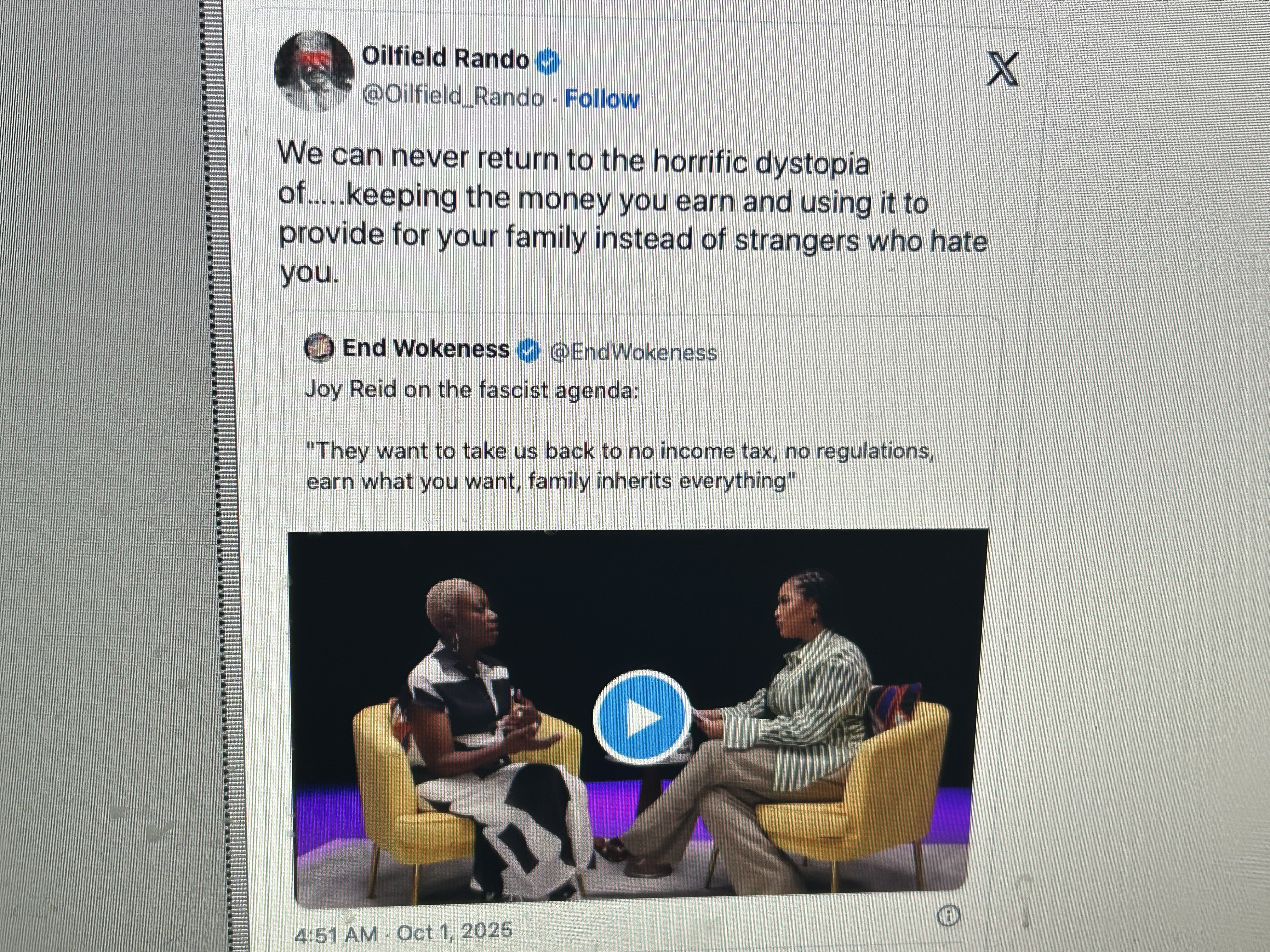
I am amazed when I see posts like the one above. People who want to do away with taxes and regulations have this idea that once they are free from taxes and regulation that they will have all this extra money to spend and lead a glorious government free life. Unfortunately the tax free, regulation free past was miserable. It is only with the expansion of government which regulated the market economy and the taxes paid by the public for these changes did this general misery end.

Once you remove taxation and regulation, people will be presented with an array of new bills which have to be paid. Things like nuclear weapons, the army, the navy, the air force, the justice system, police protection, fire protection, road repair, street lights — all these things and so much more will need to be paid for. Then people will have to figure out if their restaurants meet health standards, buildings are being built so that they will stay up during earthquakes, stopping people from dumping toxins into rivers, checking to see if every household is disposing of human waste properly, to name just a few. Who will do it? How will they be paid?

Is Government perfect? Absolutely not. Could it be done better? Of course. Is this a reason to do away with it completely. No. No more than a Market Economy can’t do everything to meet all of our needs, at least, not without the help of government.

Here is the bottom line — the vast majority of people in this country want a market economy. This isn’t going to change in the near future. In order to make this market economy work, we also need a strong government presence to ensure that the rich, people who have power and money, don’t abuse this power and money to take advantage of people who do not have power and money. This also isn’t going to change in the near future.

This means that we have to figure out a way to make these two, sometimes, antagonistic systems work together. Is this perfect? No but then no system is perfect. Ever. This is our common challenge — how to make an imperfect world work for as many people as humanly possible. It will always be imperfect and we will always be working to make it better. But, given the present interlocking structures that is our system, eliminating Government is absurd and unworkable.

I managed people who held low level jobs and limited opportunities for advancement. They are, by and large, an unmotivated bunch. They did their work adequately and left on time. They weren’t there for more than a paycheck. Good for them, I say.

One of the things my managers frequently tasked me with is how to motivate these people. And before I could say more money they then added the painful restriction without offering them more money. More money was always the hitch. The companies wanted to motivate the employees without paying them more. Needless to say, nothing we ever came up with worked.

The problem here is that the highly compensated people who run companies have convinced themselves that more money only works to motivate high level people. Low level people want something else. I attended seminars where I was told countless times that employees actually want other things than more money. They want respect. They want autonomy. They want acknowledgment. Notice that all of these things are free for the company. They are also vague and difficult to deliver for the direct managers. How much autonomy can you give to a person who has a highly structured job with expectations of coming in on budget and on time? If you didn’t deliver, you were encouraged to do better; if you did well, you got a pat on the back.

The budget for employee incentives were such that it was easiest to reward the group instead of the individual. So Donut Fridays and elegant Christmas parties were thought of enticements which never delivered the expected punch. I actually had one employee ask if instead of going to the Christmas party could she instead have the percentage we paid on a per person catering charge in cash. She would rather have the 29.99 than spend time at the party. I had to explain to her that this was a group incentive and her choice was the party or nothing. She, obviously, was being facetious but her point was made — the company was giving her something she didn’t want.

Even more ironical is that when I relayed this information to my boss, she completely understood. This to me, speaks volumes, about corporate culture — everybody knows this won’t work, but since we can’t give more money individually we are stuck we these group benefits that nobody cares about and won’t deliver. In other words, everyone knows these actions are doomed to failure from the start but continue doing them because nobody has a better idea.

I worked for a company that diligently surveyed their employees on how they felt about work. A neutral company took the survey, the results tallied and delivered to the employees. Every year the areas where my department scored lowest would be our focus to improve for the next survey. Except, of course, low pay. Everyone knew we couldn’t change that so low pay was a problem when the first survey was taken and low pay was a problem on the last survey I was there for. I am betting, with almost 100 % chance that I am right and after being away for six years, low pay is still one of the lowest scoring areas for my department.

The higher ups, convinced by seminars they attended where they were told that higher pay is not the major concern for employees, made us middle managers attend these same seminars so that we too can understand that higher pay was not the reason people worked. We learned how to encourage employees, how to discipline employees, how to reward them without giving them any money and, of course, nobody was convinced.

What is so baffling to me is this resistance to giving more money when the higher ups know the way to get people to work harder is to give them more money. This is, after all, the argument for giving rich people more money. We want them to work hard right? These people are the innovators, the entrepreneurs, and the risk takers. They have to be rewarded. If you take away their money, they won’t work very hard. But if you give them money — will the sky is the limit.

Exactly. So why should regular employees be treated differently? It is a blindness to the very economic tenets that Business so enthusiastically embraces. But by all means, continue with the Pizza Parties and Donut Fridays. I am sure one day that it will eventually work.

So farmers and hotel companies are having trouble finding replacement for immigrants who, fearing for their safety, are leaving these jobs because they are vulnerable targets for ICE raids. Trump, being a hotelier and dependent on this same immigrant labor force, is now being forced to choose between cheap labor or cracking down on illegal immigration.

The whole point of Trump and the Republican’s campaign against illegal of immigrants, as Matt Walsh points out, is Americans now will take these jobs at a higher and more livable wage. Labor will become more dear and thus business will have to pay higher wages in order to fill those jobs.

And it was not some unintended consequence of their actions. Trump and his cronies said as much in their campaign. Immigrants are taking jobs from Americans. Get rid of the illegal immigrant and the Americans would take the jobs. The problem these economic wizards didn’t count on is that Americans would refuse to do these jobs at the immigrant low wage.

You can have low pay jobs with immigrant labor (more workers) or higher paying jobs with American labor (less workers) but you can’t have low wages with just American labor. It is all down to supply and demand.

Trump, being a Wharton School of Economics graduate, should know this. That he continues to have problems with understanding basic Capitalist theory is trouble particularly since he sees Capitalism as the solution to USA’s economic woes. He was wrong about tariffs and he is wrong about immigrant labor. He also gives an inordinate value to bullying people as a method of negotiating.

Adam Smith, Milton Friedman and Ayn Rand would be appalled.

I had numerous misgivings about Bryan Caplan’s It’s Not Who You Know, It’s Who You Are. Caplan’s bottom line is that there is no advantage to being rich in a capitalist society. The cream always rises to the top and it is because the rich have better genes than the poor and middle class and this is why they always rise to the top.

How did he determine this? Did he give a bunch of poor kids a million dollar trust fund, a financial advisor and entrance into all the best private schools and then compare it to the rich kids who had this advantage already? Or did he force rich kids into resource stretched public schools, make them work three jobs just to meet rent, and made it impossible to talk to Daddy during the length of the study? A little more information is needed here in order for me to buy the bull shit Caplan is selling.

If he is just looking at where people ended up, then he failed to prove his point. Are you telling me that knowing other rich people isn’t helpful to rich kids looking for jobs? Almost every job I have ever gotten was because I knew someone in the company. I knew a job was available and I knew who to talk to in order to be seen. Being seen is half the battle in getting a job. This is a tremendous advantage over someone who knows no one. How does he factor that in to his analysis?

Why would rich people spend upwards to $100,00 a year for private education if this doesn’t give their child some advantage? If their child got the same education in a local public school, they would be a fool not to — it comes with their taxes. Yet these rich people, and Caplan believes smarter people, still spend a lot of money on a private education for their genetically superior kids. There can only be one explanation — expensive private schools make a difference. They are worth the money. If, of course, you have it.

Finally, I thought one of the assumptions of market capitalism is that poor people have to learn to work hard in order to pull themselves up by their own bootstraps. Anyone can make it to the top if they work hard, they too can become rich. But if they are too genetically inferior to make it happen, why needlessly raise their hopes if they are going to end up being poor no matter how hard they work. How sadistic is that.

Genetic superiority is a pernicious and dangerous lie. When people believe they are superior, it opens them up to differentiate between human beings. There are better people who deserve more. To diminish the value of money is equally dangerous. Why have public schools and Head Start if the kids are hopeless. You can’t spend enough money on rich kids and no amount of money will change the results for poor kids. Why waste time and money on lost causes? Nothing personal here. It is all genetic.

Throughout my work life, I have been told numerous times that my wages were in line with industry standards. For some reason, this bullshit answer actually shuts down any follow up questions regarding increases in workers wages. How can you argue with wages that are in line with industry standards? Every one else is getting the same.

But we should. Start with why is keeping wages in line with the industry standard even the goal. Wouldn’t you want to have the best wages to attract the best workers? Keeping wages in line with a standard wage is unfair to the regular worker particularly if the company is a financial success.

I understand if a company is struggling and needed wage concessions to survive, the employees might agree to those cuts in order to keep the company going. People wouldn’t be saying you have to keep your wages in line with industry standards. The company needs saving, sacrifices have to be made.

Then why would you say that when the company is successful? Shouldn’t the workers share in the success of the company?

The concern is that if one company gives their low wage workers a pay rise, that other companies, within that industry, will have to pay higher wages in order to compete. Yes, exactly, after all isn’t that what market capitalism is all about. The best workers should get best wages. But, no, this isn’t the case. Wage increases at the low end of the scale causes inflation.

This same philosophy, however, does not apply to wages at the high end of the scale. Large increases at the high end of the scale doesn’t cause inflation to the broader economy because fewer people receive them. It does, however, cause wage inflation for those few people who get them. This is why there has been such a dramatic rise in wages for upper management.

This isn’t, however, capitalism because the low wages are artificially low to control inflation which everyone agrees is important except when it comes to prices and executive wages. There is an industry standard for low wage workers and companies want to adhere to this standard to keep wages low across the industry. Inflation, you know.

So whenever I hear people moan about how bad employees are today, I ask — are you paying above market wages in order to get the very best people. If you want good workers, you have to pay for it. Right? Isn’t that the whole spirit of market capitalism. If not, then why exactly do you think your industry standard wages will get you the employees you want? It makes no sense in a capitalist economy. You should expect mediocre employees with little interest in putting in their full effort into the job because they could lose their jobs today and find a comparable job tomorrow.