The New York Post is complaining that people get too much money in unemployment benefits so they opt for these benefits over working an actual job. Boo Hoo. Let me try to shed a tear.

First, and most importantly, I don’t know where the Post is getting its statistics but they are both wrong and misleading. As a recent recipient of unemployment insurance, I can assure you that it is nowhere as large as the Post is stating. I received the maximum benefit for unemployment which was all of $450.00 a week which is $11,700 in a six month period. When I reached the six month limit, I was immediately cut off.

How the Post got $71,063 as the maximum benefit for the state of California is wrong. The statistics that the Post provided base there numbers on both adults in a family of four (2 adults and 2 dependent children) being unemployed. Highly unlikely but OK for the sake of argument lets go with it. Using California as a measurement this means $23,400 is the maximum benefit they would receive. The average cost of the Obamacare Health benefits for a family of 4 without subsidy is $1,403. I doubt that the government subsidized $38,000 for a benefit that only costs $1,403. The Post’s numbers just don’t add it.

Then, there is that the Obamacare subsidy is based on a person’s last year of income tax statement. When I was investigating whether to take Obamacare when I became unemployed I learned that I was ineligible for the subsidy because I worked a complete year and thus made too much money. I would become eligible for the subsidy only after I filed for income tax in the next year. By this time, I lost my unemployment benefits so coupling Unemployment and Obamacare benefits is misleading. The unemployed rarely, if ever, receive both benefits at the same time.

The Post also uses the maximum benefit as its benchmark. What the Post failed to advise its readers is that only the highest paid earners received the maximum. People who made lower salaries, received a lower level of unemployment insurance benefits. Yet, the way the Post frames their case, every unemployed person is making $71,063 (at least in California) on Unemployment Benefits and Obamacare. This sum isn’t even close to the truth. Most people aren’t receiving the maximum benefit and are not receiving it in conjunction with Obamacare subsidies.

Finally, and most damning of all, the present unemployment rate for nation is 3.7%. There isn’t a lot of unemployed people to get back into the workforce. Cutting Unemployment Benefits isn’t going to change this.

So what is a poor businessman to do? The answer, rooted in Capitalism, is he should raise wages so he can attract workers. Perhaps stay at home mothers, retirees and students might be enticed into the workforce with higher wages. Why not give it a try and see what happens? But, no, the Post would rather complain about the lazy nature of the American Worker instead of recommending that businesses adapt to the present economic situation and pay higher salaries.
Hallelujah. Although this will comes as no surprise to anyone in the corporate world, research shows that too many meetings are bad for both the employee’s state of mind and, because of that, corporate productivity. I particularly like the observation that if someone isn’t given a break from meetings that they take one anyway — it just is in the meeting. So, while the person’s body may be attending the meeting, the person’s mind is elsewhere.

All of this would seem obvious. Schools give children recesses for a reason. It is difficult to focus on a subject for terribly long and, in order to help the child’s retention, there is play break. Children come back from recess more energetic and ready to study. Somehow the work world has bought into the notion that adult human beings are somehow different from children human beings and thus can endure a day filled with meetings. They can not and the science shows this.

Multiple meetings in a work day is a relatively modern concept. When I started working in the1980’s, a day of back-to-back meetings was rare. People worked and the occasional meeting was held. Meetings were so rare that they were often accompanied with donuts or cookies. Sadly, the treats have been ditched and the meetings are innumerable and endless.

I blame computers. Now, I don’t have any proof but the more automated my company became, the more meetings the company seem to call. I am guessing this is because while human beings made mistakes with non-automated processes, the process itself very rarely changed. If mistakes were made, the employee may need retraining but the process stayed the same. With automation, on the other hand, procedures changed on a regular basis because there may be a problem with the automation. This meant that a workaround was needed to to keep the business running. People needed to talk about the workaround because one department could easily implement the change while the workaround would bring another department the brink of disaster. People understandably had to talk.

Automation brought a slew of meetings. People needed to know when the system was down and when it could be brought up. They needed to know that the system was performing certain functions incorrectly and what to do if you experienced it. They needed to know that the system was being updated and what information you needed to give your employees. Meetings and more meetings were the result.

Then teleconference came along and meetings, at least in my mind, went out of control. They became so frequent that some days I found myself in back-to-back meetings for days. I worked for a European company with a huge presence in Asia. I now began to have teleconferences at odd times – say 6AM in my morning. Last minute meetings became the bane of my existence. I could dutifully check my next day schedule for meetings before I left work each day and find a new meeting invitation on my calendar. Someone, while I was sleeping, decided to call a last minute teleconference. And I wasn’t that important of a person. The big wigs, more often than not, are behind closed doors for days on end.

I could live with this if the meetings were really necessary. But most of the time, they weren’t. There were check-ins. How are things going with this project? Fine. Do you have any questions or need my help? No. The meeting was over in 5 minutes which is really annoying after I carted my ass out of bed at 5AM in the morning. Or, worse still, I shouldn’t have been invited in the first place? I have sat through meetings in which I have sat quietly while people talked about something I knew nothing about, waiting patiently for my role to be revealed to discover that there was no reason whatsoever for me to be on this call. I once had someone claim that it was courtesy to keep me in the loop about the project. Why would anyone invite you to a meeting with no expectations that you have anything to contribute? I understood nothing that was said because I knew nothing about the project. If I was asked by anyone what the project was about, I could maybe recall the name and little else.

So, as you can see, I am happy to hear that people have begun to see the productivity issues related to too many meetings. Hopefully someone with power will take this new information seriously and tackle the proliferation of meetings. I am betting there will be a meeting coming to your Outlook calendar soon. Don’t thank me.

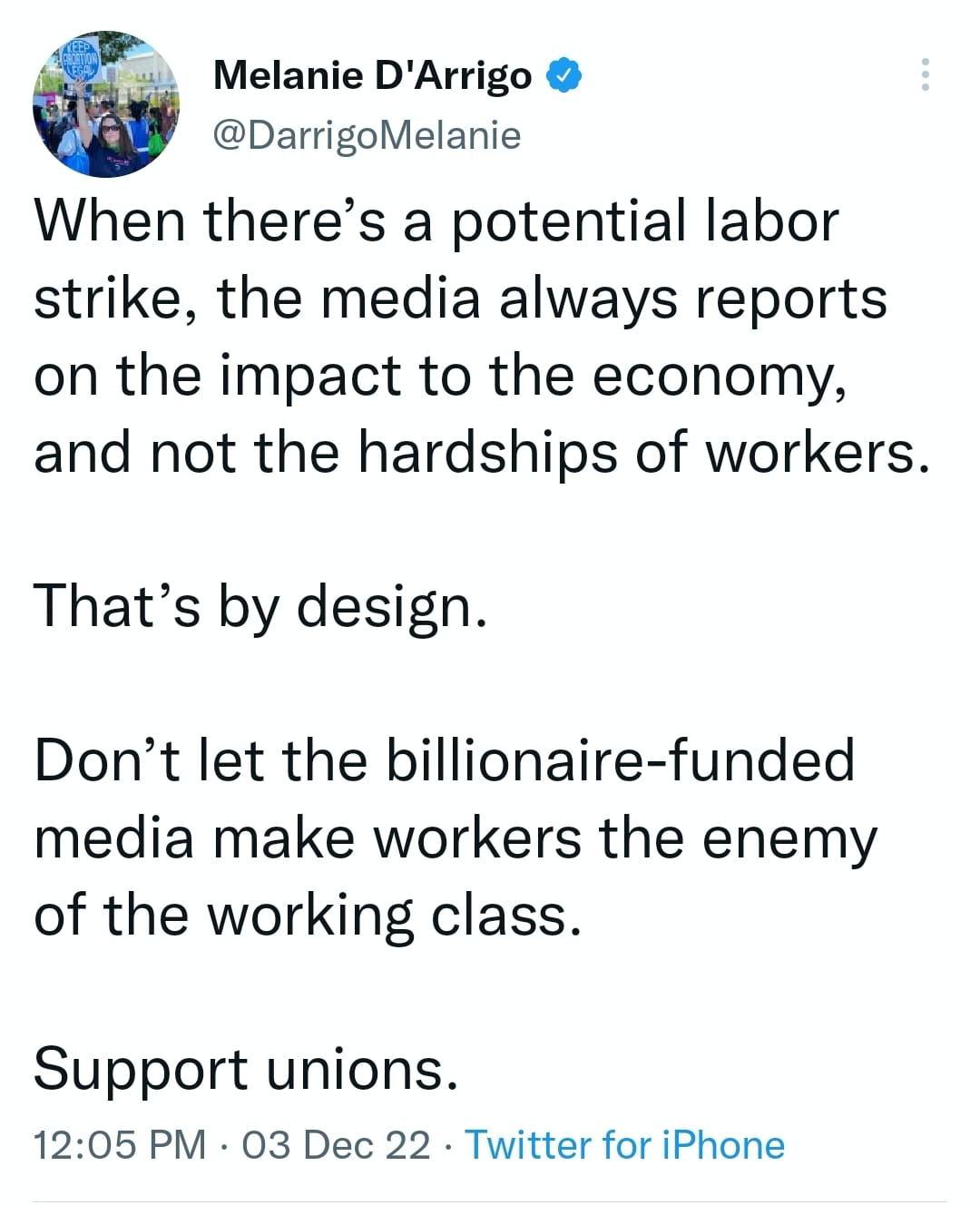
I saw the above statement on Facebook the other day. I am assuming that this tweet is in regards to the Congress’ recent rolling over of the Railroad Unions in regards to sick days. I agree with the writer of this tweet that some of this antipathy towards workers in general and unions in particular is created by the business owned press. Still, there is something in the American psyche that supports this tendency. If it is a choice between helping individual people or helping business, Americans will support business.

Sick days, which in every other Western country is a given, are not mandatory in the USA. Some businesses offer them, some business don’t. More and more businesses are going to a time off option — the employee is given so many days off in a year. Which really means that the employee has to take sick days from his vacation days. (Imagine a person from HR here. She says something like you can take these days for your trip to Europe or if you have a nasty flu. It’s all up to you. Isn’t it fabulous all the freedom that the company is giving you). Business believe that sick days are unaffordable luxury and will drive them out of business even though every other Western country require sick days and continue to operate successfully after making them legally mandatory. People get sick. People also need paycheck. If an employee doesn’t get sick days, this creates a problem for them. Their choice is come into work sick or stay home and lose pay.

Both options are bad ones. They force workers to choose between their income and their health. Yet, despite the world’s recent experience with COVID, mandatory sick days for employees still is not required in the USA. Why? Fear mostly.

The big fear is the reaction of business. Fear that business will resist the better treatment of workers. If the company declines to negotiate and then the employees strike, the burden of the strike falls on the workers. Labor will be blamed for any economic consequences related to the strike. All the talking heads spouting off about the Railroad workers were worried about the economy and what a disaster a strike would be for the country. The consensus was that the Government should do whatever it takes to prevent a strike. Somehow missing from these discussions was that the railroad workers still don’t have any sick days and are left with a difficult decision every time they are sick. Workers reasonable demands can be ignored if the economy is at stake. But, of course, the economy is always at stake.

Americans have a curious attitude toward business. The big idea is that cities and states should do everything possible to keep businesses located in their jurisdictions and labor should be damned happy to have them. Businesses provide jobs. These localities give all kind of inducements to business – tax breaks, cheap land, paying for the workers to be trained, all kinds of tangible benefits to keep businesses from leaving. The government thinks that once they have secured the business through these inducements that they have won the loyalty of the business. The business, on the other hand, views this as a temporary measure and is always pressing for better inducements with the threat of leaving always hanging over the localities.

But if workers ask for better treatment, Americans think why are these people screwing with business. Who knows what the business will do now that intransigent workers are making financial demands? Business will remind the localities that businesses can operate anywhere and can relocate operations to a cheaper and more pliant labor force if workers don’t quit their griping. If labor isn’t careful, businesses can also automate more of their work which will eliminate more jobs. Is that what the workers want? The picture is always framed that the business are just trying to make money while the employees are making unreasonable demands that can drive the business out of the community.

The mere idea of an employee asking for better treatment is a bad look. Most Americans work for non-union shops so are used to businesses telling them what their raises are, what the health benefits are and how many sick days they have. There is no negotiation between two sides. It is one side telling the other side what they will get. To the American mind, this is the way labor relations are handled. Any time workers make demands, the American public gets the vapors because how dare workers challenge businesses with their own ideas of what they should received in wages and benefits. This is for the business to decide. What will business think of our community if these workers keep making demands?

Thus government and labor think that they are making every possible concession to keep businesses in the community least the government get blamed for driving businesses out and causing unemployment. This places communities in impossible position of giving more and more to keep businesses happy and getting less and less in return from the businesses. Despite all those terrible demands from labor, the railroads are the most profitable business in the USA. But, of course, paid sick leave would drive them out of business.

Last week Frontier Airlines announced they eliminated their phone customer service. From now on, customers will have to get information electronically or with live chat. They believe that their digital communications system will “ensure our customers get the information they need as expeditiously and efficiently as possible.” How they determined “expeditiously” is beyond me? My personal experience with web sites is mixed at best. Yes, sometimes, I can find my answer quickly. More often than not though, my digital communications encounters are a trip into Internet Hell. Not all situations are the same. Reconfirming a booking is easy electronically. Correcting an error in a booking is a different story altogether.

This is particularly irksome in situations when I know a company employee can answer my question almost immediately — saving me time, ensuring that I have a clear understanding of my situation and stopping me from frustrated searches through numerous web pages. I guess it is pretty selfish of me to want a quick answer from a company employee when I can just as easily spend hours searching for the right page. Frontier, will counter that there is live chat if I need to reach the company directly. But, and here is my big problem with live chat, I only contact the airline when the digital tools they provided me have failed to help me. I only call when I am desperate. So, while live chat may be an option, by the time I resort to it, I am already frustrated and I just want help. At this point, typing out the details of my questions is just fueling my anger about the lack of help I have already received.

I want to talk to a person when I reach this level of frustration. It makes me feel better. I know that the company understands my problem and I know that someone is working on my problem. But, you say, Live Chat can do that too. It is exactly the same thing except you are communicating through the web instead of a phone. Maybe but I prefer talking to a person and Frontier won’t let me because its position is incredibly limited to the point of arrogance, they are forcing customers to use their digital tools. If a customer has the temerity to call their customer service phone number, the system will eventually hang up on them. Disconnecting customers who want to use the phone is irritating and insulting particularly when last week your company would have answered those same calls.

What irritates me the most is the glaringly dishonest corporate spin that introduced this change in service. The notion that Frontier is providing the the same level of customer service, if not better, than the company delivered before is quite clearly wrong. Nobody hung up on a customer’s phone call a week ago. This is a cost cutting exercise and it has nothing to do with better customer service. So don’t tell me I am smelling roses when I know it is bullshit.

The ace up the capitalist’s sleeve is that most people like some of the products and services that Capitalism provides. I know I do. Socialism is focused on the basics — reasonable housing costs, reasonable health care costs, fire and police protection, and education. All necessary services but not much fun. Capitalism is fun, Capitalism is a trip to Disneyland, gambling in Las Vegas, seeing a rock concert, attending a football game, drinks with friends on Friday Dinner, a nice diner on the town, a flashy convertible, and any of the thousands of other amusements that consumers distract themselves with. Socialists want to guarantee you a minimum standard of living while Capitalists want you to have a good time. These are two very different experiences.

This is why I find myself very much a mixed economy person. Yes, I want government services but I still want a good time. And this is why getting rid of Capitalism is nearly impossible. We have had the power to stop Capitalism for years. All consumers would need to do is stop buying the unnecessary goods and services that Capitalism provides. Which is practically almost everything a modern persons wants, so this also is why it won’t happen. I mean a Socialist Utopia is a great idea and all but if I have to give up cable television to get it, my decision becomes more difficult.

Giving up consumer items is a difficult sell even to the most sympathetic audience. I was talking with a woman who was railing against business mentality and capitalist greed. She couldn’t understand why people balked at paying more taxes to help the poor. I suggested that we all stopped buying unnecessary consumer items and just buy necessities. If there were no consumers of these products, the businesses that provide them would soon fail. She considered it for a moment and I could see her struggle. Finally, she said, “But I like my things.” And that my friends is the problem. Socialism requires a certain level of surrendering pleasures so that everyone can lead a better life. This is an increasingly difficult argument to make.

A hundred years ago, this same argument would get a better reception because so many people lived at a subsistence level. There was nothing to give up because there was nothing to spare. A broad swath of the Western Middle Class has been having a lot of fun since the end of World War II and they aren’t about to give it up, and, not surprisingly, Socialism has lost its allure. This leaves us with the struggle ahead — how do we make Socialism more fun?

The CDC found that over 50% of all Americans will at some point in their life be diagnosed with a mental health disorder, that 1 in 5 Americans will have a mental health disorder within a given year. A recent study from Indiana University found that 45 % of all emergency room patients are also suffering from mental health issues.These are large and significant numbers of people who need help. These are people falling into drug addiction and alcoholism. These are people who might snap and take a loaded gun into a shopping mall. Because mental health diseases are so widespread, almost ever American is affected by them. If these were physical ailments, alarms would be blaring across the country.

A yearly physical check-up is routine for most Americans — particularly after you have reached age 40. The check up is done whether the person is feeling healthy or sick. The yearly check up allows a doctor to evaluate what is going with the patient from year to year in the hopes of catching and treating hidden diseases earlier than waiting until the patient develops full blown symptoms.

Mental health, on the other hand, is almost always a reactive action. The person breaks down and his condition, now obvious, has to be addressed. This is hardly an effective approach. Early treatment is a better, cheaper and less toxic approach. Why wait until the person has mentally fallen apart when, if the person had periodic psychiatric check ups, any mental health issues can be addressed before a person has hit bottom.

Working with young people is a great place to start such a practice as mental illness often emerges after adolescence. It is also during people’s youth that they are free from parental control and are experimenting for the first time with alcohol and drugs. These illnesses and addictions would be found earlier and hopefully addressed before irreparable damage is done to the person. One of the reoccurring horrors of American life is mass shootings. Every time these shootings happen, people ask the question — what can we do to stop this from happening ? Since gun control is off the table, why not require universal mental health checks for every American — particularly young men who are most prone to these crimes. If mental health is the problem, then we need a mental health solution. A mental health check up fits the bill.

A lot of people still believe old ideas about mental health. It is a personal weakness not a disease. They claim that people didn’t need mental health professionals in the good old days. People were stronger. They just toughed it out. None of which is true. There is absolutely no evidence that people were tougher or stronger in the good old days. First, nobody measured it in the good old days so there is no way to prove this assertion. Also families hid away their problem members if they could so Grandmother never talked about crazy Aunt Alice. There is no better example of the widespread addiction problem in the USA in the good old days than Prohibition. The level of alcoholism was so bad that Americans actually banned alcohol consumption. The good old days weren’t so free from mental health diseases and addiction.

The good old days were free from effective treatment of these disorders. And this is why it is time for Americans to move away from the shame model of mental illness and go to the proactive treatment of mental illness. Nobody wants to be sick from cancer, the same thing applies to mental health. Nobody wants it. It is a horrible experience. Once of the principal reasons that cancer survivability has dramatically improved in the last century is medical professionals are now monitoring their patients and catching it faster. Why not try the same approach with mental illness?

Apparently Jeff Bezos has billions of dollars to burn through and is looking for people to help him. He just donated a $100 million to Dolly Parton. It is presumed that Parton will help Bezos distribute his extra money to worthy charities. Given her history, I believe that she will. Parton has proven herself a generous woman as she is credited with giving Vanderbilt Medical Center money in order to help find the COVID vaccine.

But, with absolutely no animus towards Parton, why give her even more money to give away. She has so much of her own money that she is already giving it away. So Bezos gives her even more to give away? Whenever I hear about money transfers like this I have to ask, why not take this money out in taxes and let our legislatures determine where it goes. The money is there. The rich are giving it away. They clearly don’t need it for their business. Why let billionaires decide where the money goes?

I can hear people say the Government will only waste it. Perhaps. But there is a fundamental difference here. A Republican led government could put the money to tax breaks, bringing down the national debt, or helping energy companies find oil. Democrats can use it on providing better social services. The key here is that in both cases a number of people are looking at the public good and making a decision that they think is best for the country. I might disagree with the decision but I feel better about a legislative body looking into it than having a single billionaire deciding on a whim.

I mean what if Dolly wants to talk to the animals? Based on her desire, she drops the $100 million into charities that work with humans trying to talk to animals. A noble enterprise I am sure, but is it really the best use of money when we have so many other pressing needs? And, more importantly, why leave this decision to one citizen. And really why does any citizen have so much money that they are giving away $100 million to another wealthy person.

Since Bezos has $100 million to give to Dolly Parton, it mean he can pay more in taxes without a detrimental effect on his life or his business. He is giving it away already. I say if you are giving away $100 million you are begging to be taxed more. Let’s do it.

I was surprised to see this article about teens illegally working for PSSI, a company that cleans up for meat plants. So here we are in 21st Century USA where companies hire underage labor to do their work. In this case, the work also is dangerous because it requires the use of toxic chemicals and machines capable of killing a person.

PSSI claims that it did a thorough check. It is not their fault if these precocious teens used false documents to get their jobs. This argument will probably get them off the hook. The company may have to pay a fine, an upper management person might have to fall on his sword but when all is said and done the country needs people willing to clean the dirty floors of meat plants.

The teens in question were immigrants which makes me curious about this company’s HR practices. Being immigrants, I would think the company would be particularly careful when a prospective employee provides this information. The Federal Government requires every employee to prove that they can work legally in the USA. This is the whole reason for law. But 31 underage teens got employed. I mean I can give PSSI one or two teens getting through a rigorous vetting of the documentation but 31 suggests something altogether different. HR was either not checking them at all or not caring that they were fake. Also forget the documents, I suspect that some of these teens actually looked like teenagers. There were 13 year olds working at the meat plants. That someone in charge wasn’t a bit startled to see all these fresh face youths working in the plant and not question their age is alarming.

This raises another question for me. If PSSI wasn’t checking documentation to ensure the age of their employees, how well were they checking the adults they hired for their immigration status. I suspect not very well at all. Which gets us closer to the real problem — PSSI can’t get many American citizens to do this dangerous job for the wage they are paying. I mean why else would they overlook the law regarding underage employees. The company was taking a risk. The fines are probably minimal and, mark my words, there is probably a tidy sum set aside for just such an exigency. So if a company needs to pay low wages with little risk of getting caught and minimal financial hardship or legal punishment if they get caught, what is a company to do? Hire the most vulnerable and desperate people and hope they don’t get caught.

Capitalists are pretty adamant that prices must follow the market. If there is less of a product and high demand, the prices go up. If there is a surplus of a product and low demand, the prices go down. The same, at least in theory, applies to wages. Except it doesn’t. Companies set the wages they want to pay and then find the people who will work at those wages — even if they have to act illegally to get those employees. They would rather illegally employ children in dangerous jobs at low wages than up their wages in order to attract a legal adults. This is not how market capitalism is supposed to operate.

It makes me curious as to why the Republican Party has not latched on this particular problem. They oppose immigration. They say they want Americans in good private industry jobs. Enforcing child labor laws and immigration laws would seem like a no brainer. Make it difficult for companies to employ illegal immigrants and children. Hurt companies with hefty fines and imprisonment of executives who break these laws. If there are no jobs for immigrants, a large wall on the border would be unnecessary. They wouldn’t come.

Of course a large wall on the border would involve all kinds of construction and money, money, money for everyone and the immigrants would keep coming. Business secretly wants these low wage immigrants because they can control them better than American citizens. If the Department of Labor started enforcing labor laws, it would get messy fast. The Federal Government might see how business actually operate, the government might even try strictly enforcing these laws which might force companies to pay higher wages.

This is why we have children in 21st Century America working with toxic chemicals at dangerous jobs.

Ten years or so back, I stopped watching movies set in Concentration Camps. I got the point even before I began watching the movie — concentration camps were horrible places, human beings can do horrible things and we can never let this happen again. I agree. If I never watch another movie about Concentration Camps, I will still remember this. It is permanently lodged in my memory as few other things are. Watching a new Concentration Camp movie isn’t going to change anything.

So what if a new Concentration Camp comes along that surpasses all other Concentration Camp movies in artistic merit, in messaging, in production values, in acting — shouldn’t I see the movie for the art? Maybe, but I don’t want to. That’s all I can say. I don’t want to. I feel like I am wasting my time seeing an excellent rendition of something I already am convinced was horrible. Just because something is done well, doesn’t mean I need to watch it. I am not required to see all good art. More importantly, it just depresses me. Why put myself through that even if it is great art?

I once slipped and started watching The Boy in the Striped Pajamas because everyone was raving about it. The premise of the movie is that the German son of the Concentration Camp Commander befriends a Jewish boy through the fence of the camp. The fence is no match for the industrious German boy who soon visits the Jewish boy in the camp. I am betting that most of you can see where this movie is going. Tragedy. I stopped watching when I figured out where this story was going. What point was there in seeing the end? So I can see a well done depiction of a horror that I have seen many times before? How was this going to make my life any better?

This is how I feel about the recent television series Dahmer. I have very few complaints about the series. There is great acting, great production values, and an interesting story. Yet I hated almost every great minute of it. Dahmer, as portrayed by Evan Peters, is an inarticulate loner with an unchecked alcohol problem who tries, always unsuccessfully, to make friends. He has an early fascination with taxidermy which may lead him to his future murderous actions. He stumbles into his first killings but, after these “accidental” murders, he realizes that killing and cannibalism are the only things that satisfies his sexual urges and thus begins his descent into serial killing.

There are 10 episodes in the series which easily could have been cut down to 3 to 5. Yet, the movie goes on and on showing him preying on his victims, his family complaining about how strange he acts and why doesn’t he behave like a regular person, his neighbors complaining about his strange behavior and meeting with police indifference to this strange man and his strange behavior. Yes, it’s well done. So what? Dahmer is difficult person to connect with so, despite all of the episodes, his motives are still baffling at the end. He is a seemingly bland ordinary person who, for no apparent reason, descended into Hell and brought every person he meets into Hell with him. There is no suspense, no identification with him as person, and no hope that anyone could ever stop future serial killers from slaughtering their victims.

And, because there are 10 episodes to fill, the producers and director keep showing the same terrible situations over and over again. But, just in case you missed it or didn’t understand it before, the series gives the audience a fairly comprehensive accounting of what a monster Dahmer was. If you need this confirmation, by all means, see Dahmer; otherwise try to find some other well done television show, or book, or painting that enlightens you or entertains you or makes you look at life in a different way because Dahmer is a well done bummer.

Most importantly, always remember, you don’t have to see something because it is good.

I use to worry more about election results because I thought that whoever won the election, now was responsible for governing. With age, comes wisdom. I now realize that elections might tip scales in favor of one party but there are so many institutions that a law must pass before it actually takes affect that it is nearly impossible for radical change to happen in the USA. At least not immediately.

This daunting process involves the House, the Senate, the President, and the Supreme Court. All of these processes may cause changes that require the law to start the whole process from the beginning. The filibuster, as one example, requires a super majority for passage in the Senate, and as we have all experienced in the past few years, it slows the process down considerably. Then there is the Federal System. Each individual states can make their own laws that can run counter to the federal law which then may have to go to the Supreme Court. It just isn’t easy to change things here.

The Founding Fathers, in their infinite wisdom, created so many road blocks to change that it is really difficult to get much worried about an election. Rarely does one party have safe control of all the levers of power to get what they want and, even if they did, the individual states would provide another barrier.

What about the January 6th coup? Yes, it is concerning but, interestingly, the system did work on January 6 even with a bat shit crazy President, the active participation of some members of Congress and right wing kooks storming the Congress. Despite all of that, Biden took office without much problem. Most active opposition to Biden taking office took place after he was safely in the White House. Enough Republicans did the right thing in January to ensure that Biden became president. Months later, they denied any participation but, by then, it was too late to change presidents. It was a craven bow to their angry voters but, in no way, something to worry about. And let’s be clear the Republican Establishment hates Donald Trump just as much as the Democratic Establishment. They aren’t interested in revolution as much as they want to keep their money safely hidden from the hands of the tax collector.

Both parties have a tendency to demonize the opposition party. If the Democrats win, socialism will follow. If the Republicans win, facism will follow. It never does though. Elections come and go but before much of anything can really happen, the system grinds through the process and comes up with some version of the change that the majority can live with.

Democracy, unlike revolutions, is a pretty boring process. It takes a lot of to and fro with different competing interests and it takes forever to get anything done, but, it is a much better path than revolution or civil war. I know it is difficult to deal with Republicans who, in my humble opinion, want to stand in the way of progress. They won’t listen to reason and are unwilling to make meaningful concessions.(Republicans undoubtedly think the same about me). But, then, imagine how much more difficult it will be if there is blood in the streets. Will the dead bodies of friends and relatives make it any easier.

The end is not nigh. The country is going through difficult times but the country is always going through difficult times. The Civil War, the Great Depression and World War II were all dangerous times and we weathered them all. Now is not the time for sword.