Well, the news out of Texas just keeps getting better and better. Not only must a woman give birth to a baby which is doomed to die, the state takes a deem view regarding historical information about slavery. Michelle Haas, amateur historian, believes that the Varner-Hogg plantation, a Texas state historical site, had too much information about the slaves and not enough about the slave owners. You heard me right. The slaves are getting more attention than the slave owners. The horror.

Whats more troubling is that it took only one person complaining for the Texas Historical Commission to throw in the towel. They voluntarily removed the books about the slaves because they were afraid that the Republican-controlled Legislature would be upset by her complaints. One complaint and the Commission gives in. So much for Don’t Mess with Texas.

It begs the question what books about plantation owners are acceptable to Haas? Gone With the Wind?What happens when someone complains about Scarlett O’Hara and Rhett Butler? Are they going to remove it as well? At this point, you might as well close down the store completely because everything is offensive.

 Which is the point after all. This isn’t just about protecting children either, this is about keeping information from adults too. One of the books removed was Alex Haley’s classic history of his family’s experience of slavery. It’s appearance on the bookshelves is there to remind people that there were also slaves at the Varner-Hogg plantation and that plantations needed a large work force of unpaid labor in order to function. What exactly is the problem with discussing slavery? It existed at the Varner-Hogg plantation. Knowing about slavery would help a modern audience understand plantation life. I think most adults can handle this information.

And why do I need to know more about the owners? Of all the plantation residents, their place in the hierarchy of the plantation can be understood by the dimmest kindergartner. They collected the paycheck while the slaves did all of the work. What else did they really do? Give parties, run for the state legislature? You can remove the owners from the story and still get a pretty good idea of what happened on a plantation. On the other hand, you can’t remove the slaves which might also explain why there is more information about the slaves. But, by all means, tell me more about the owners.

And, while you are at it, please spare me the heart warming stories about how well they treated their slaves. It is irrelevant and frankly unbelievable. Owning a person, by its very nature, is bad treatment. Knowing any more about them, can only give people a worse opinion. Now if I can hear about why they thought they had the right to own slaves? Or why Africans were the people they were willing to enslave, I am all ears.

Also don’t tell me that slavery was a worldwide problem and that lots of people had slaves at the time. This isn’t exactly true particularly in European countries. Most of Europe had already outlawed slavery by this time and there were a lot of Americans opposed to slavery at that time so it wasn’t a universal belief. These slave owners clung to an outdated concept of how to treat their fellow human being. This is precisely what the Civil War was about. The slave owners, in case Haas’ throwing sand in your eyes has blinded you to the fact, were on the wrong side of that war.
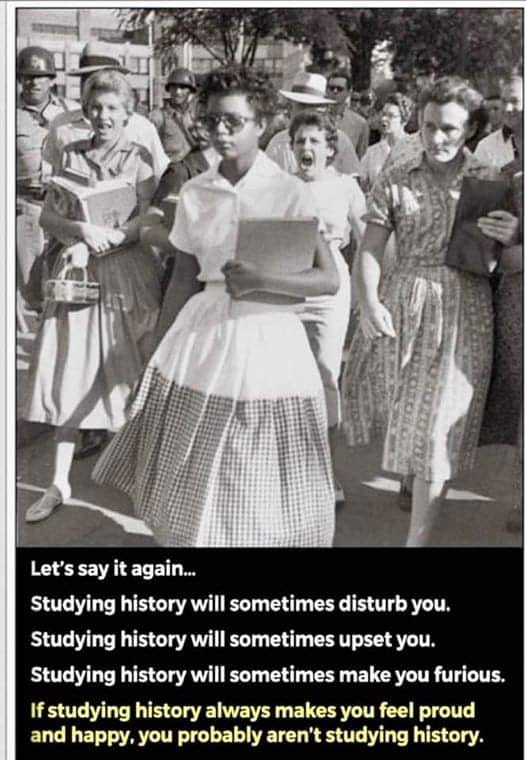
Oklahoma School Superintendent wants the truth of the Tulsa Race Riot to be taught but he also doesn’t want White kids to feel badly about it. Governor DeSantis in Florida feels the same way. What is the proper emotion for White kids to feel after learning about racism? It seems to me that is up to the individual child and is uncontrollable and not really the business of the educators. Some things will make you feel pride and other things might make you ashamed. There is no right way to feel about the past because people are still arguing about the past.

How do you take the White Racism out of the Tulsa Race Riot? White people targeted black people based on a run in between a Black man and a White woman. White people killed hundreds of Black people just because they were Black. White people either participated in the riot or did nothing to stop the riot. Should a White child feel badly about being White and the behavior of his race? Well, yes, if they are decent human beings. White people did a terrible thing to Black people. Thems the facts.

This idea that history has to show the American past in an admirable light seems incredibly wrong headed to begin with. First, history is about people. People are fallible. People sometimes do terrible things. The Civil War was one of the significant events in American history. In order to understand what happened and why this was so important in American history, difficult subjects have to be addressed. It doesn’t put everyone in a positive light. But I don’t think it will be any more traumatic than teaching first graders that one day an active shooter might appear in their classroom and how they should act when this occurs.

What doesn’t help is for educators to be even handed about a subject where being even handed is absurd which is what the Florida Department of Education tried to do. They were concerned that the slavery discussion was too one sided for the anti-slavery side. You heard it right. They wanted children to have a more positive view of the slave owners. This is dumbfounding. Why is that so important? Why can’t some White people be the villains in this particular story?

The discussion regarding the skills some enslaved people received is raging due to a Florida text book singing the praises of plantations at trade schools. I put my two cents in here.

What is interesting is that the a lot of conservative feedback is focusing on the truth of what is in the text book and not the relevance. The line causing the controversy is about the skills that a slave might acquire while working on a plantation which is really a weak way of trying to find something good about having been a slave.

I will let the historians debate the veracity of the statement because I think there is a bigger problem than the truth here. Who cares if it is true? How relevant is it to understanding the Civil War and Reconstruction. The vast majority of the slaves didn’t receive that training so when the Civil War ended the only skill they had was field work. That a few lucky individuals were blacksmiths while slaves and were able to take that skill and make a good life for themselves is a great story but not particularly illuminating on what happened to the millions who did not.

It is a trick. It allows Governor DeSantis to soften the horrible image that white children might conjure when they learn about their slave-holding ancestors. Because White children, for some reason, shouldn’t have to learn about how wretched the slaves were actually treated. Why they may begin to hate their ancestors? And I say good. It is about time.

This also exposes a much bigger problem with American History. There is a tendency to highlight the successes of a few individuals and say this is what is possible. This is actually what could happen to you. The other side of the story is downplayed. The millions of people who don’t make it out of poverty or don’t make a million dollars. Stories just as true as the success stories but, for some reason, we don’t want to tell. Numbers and statistics aren’t personal stories of success. They are abstract so the child can’t see themselves in this personal story even though it is every bit as likely, if not more likely, as making a million dollars.

All these complaints from employers who have to deal with young people with high expectations of their employment might be better addressed if we gave children a more realistic history of what might happen to them. They might understand that world a bit better and not be so disappointed when it doesn’t happen to them. Maybe we should teach them that hard work is often unrewarded. And talented people sometime go unrecognized. The good guys don’t always win. Sometimes bad things happen. Sometimes people, even leaders of our country, do horrible things. We want kids to have this glorified image of what America is when it is a lot more complicated than that.

There is this fear if children learn the truth that they will just give up on their country. The thing is they do eventually learn the truth but in the process they will also learn that people they trusted, the teachers and the parents played fast and loose with the truth. How is that better?

Governor Santis is having some effect in his effort to rid history text books of anything that might upset a student. A new Florida textbook now includes a statement that some slaves learned marketable skills from their time on the plantation. Really. You don’t say. That is the first time I’ve ever known that plantation doubled as trade schools. But interesting nonetheless.

So what it sounds like to me that there was some kind of trade off occurred here. The slaves worked the plantation while learning marketable skills that would help them in the future. Is this giving any 21st child any idea of what happened on a plantation? It is a completely meaningless statement without context of the time, the skills they are talking about, and whether they were relevant to the individual’s future.

History books have to cover hundreds of years and numerous topics. The history taught in the grade schools are broad brushstrokes focusing on the most important information. The things you would want children to remember. I challenge Governor DeSantis to show any Civil War historian who would prioritize the job training at plantation trade schools.

I am sure the publisher told some poor text book authors to make slavery sound a little less horrible and, after several stiff drinks, and failing to come up with anything, decided this little ditty would work. It’s incredibly weak and patently dishonest. There is some outrage about this now, so maybe something will happen. I’m not very confident though, unfortunately, there are so many things to be outraged about and so little time to focus on all of them.

I struggle with White Privilege and White Guilt because a lot of White people think there is no reason for it. The Civil Rights movement won the battle. It is illegal to discriminate against anyone — Black, Brown or White. Now, can you kindly stop talking about it.

Why stop talking about? Do we stop talking about other historical events? Say the Revolutionary War, the Declaration of Independence, the Constitution, the Civil War (battles only) and any other historical event. We don’t. Why is it so important for people to stop talking about Racism?

I was reminded of the reason the other day when a friend posted the following picture to Facebook.

The picture of Black teenager surrounded by a crowd of angry White women reveals everything. White people don’t want to think of Grandma as some racist thug. They want to think of her baking apple pies and reading bedtime stories. Don’t you dare take that memory away from me. The truth here is very difficult for white people because our ancestors are the villains. And that means acknowledging that Grandma might have been a racist thug.

The founders of the country, by and large, shared this prejudice. Anyone studying this country’s history needs to study this. An ideology of racial superiority was created that enabled white people to enslave Blacks and deprive them of their rights. This too is important to study. Millions of White people for hundreds of year either actively stopped Black people from being treated as their equals or did absolutely nothing to change this situation. This means, particularly for any white whose family arrived before 1965, that unless their family were known civil rights activists, their family is in some culpable in this racist enterprise. To understand our history, this too has to be examined.

I know for certain that my ancestors, all who arrived before 1870, are suspect. I know of no civil rights activists in my family’s past. I have no record of them being KKK members or belong to any racists organization so they are in that large group of Whites who did absolutely nothing to help Blacks win their rights. Their silence allowed racism to flourish. Why were they silent while Blacks were lynched and deprived of rights? This is a question worth pursuing. This means looking at racism and how it affected White people’s behavior.

It is painful. I get why people don’t want to look at it. It doesn’t fit into our nice tidy story of hardy European immigrants braving the Atlantic and hostile natives to settle our country. But, unfortunately, that story, in no way, will help you understand American History.

I always thought that the study of history was a depressing exercise. History mostly chronicles conflict and change.  Wars, famines, and economic catastrophes are all pretty sad reads. Still I understand that the study of history was important because we want to avoid making the same mistakes again. History is a guidepost on how to have a better future. 

Governor DeSantis of Florida thinks otherwise. He thinks history should make students feel good about themselves and their country. Anything that challenges this sunny outlook should be axed from the curriculum so that nothing deters students from turning into patriots that love their country. But, is feel-good history actually helpful in understanding the past or, even more important, truthful. 

How does feel-good history work?  And, if balance is important, how do we discuss controversial topics without making some people feeling angry or upset.  How does one discuss slavery without also talking about America’s racist past? Or Jim Crow laws? Or the Tulsa Race Riots, or the European settler’s treatment of indigenous people. These topics require some basic understanding of racism make any sense. And, if racism is discussed, how can you prevent some students from feeling bad about what their ancestors did? 

If in Governor DeSantis’ efforts for balance, educators reduces events like the Civil War to a conflict between two groups of good citizens who disagreed about State’s Rights then his balanced approach will leave students with a warped view of what happened.  The Civil War was about slavery no matter what Confederate Apologist say today.  I know my position is correct from a cursory review of what Southern newspapers at the time were writing about and what Southern politicians at the time were saying. They weren’t talking about State’s Rights, they were talking about Slavery. Again, how would white students feel about learning this? I think some white students might feel badly about it.  And, if you didn’t talk about racism, wouldn’t students of color feel badly because that their history isn’t represented truthfully? Then, would Governor DeSantis skip talking about the Civil War altogether in order to avoid any hurt feelings? Really, if he wants to stop hurt feelings he would ban the teaching of long division which has caused more misery for students than any other subject I have encountered. 

Governor DeSantis wants history taught with heroes and villains. King George was a villain and George Washington was a hero.  History is a lot more complicated than that and incredibly messy. Because of that, it might make some students feel uncomfortable. What happens if we take away all the heroes in history?  Who will students admire? May be students will have a better understanding of history.  Maybe they will realize that people in history are indeed people.  People who make mistakes, believe things that are wrong, and behave badly sometimes. Maybe they will learn that heroes are not perfect. If the purpose of education is preparing people for the future, then I would prefer students who see the humanity in heroes over students who mindlessly worship people as heroes. 

Whenever anyone talks about the dangers of Critical Race Theory (CRT), I think of my 12 years of Catholic education. The purpose of Catholic education, or so my parents thought, was to deliver good Catholic adults. It failed miserably with me and my brothers and my sisters. Not a good Catholic among 5 children. If after thousands of years of practice, the Catholic Church can’t deliver even one child out of 5, I really don’t worry much about CRT indoctrination. If the hidden agenda of CRT is making bomb throwing America hating Bolsheviks, I am confident that the marketing departments of America’s commercial enterprises will triumph over the theoretical dogma of CRT. 

People are pretty practical about grand theories. If you ask the average Catholic about the Church, they could care less about why the Church encourages Infant Baptism, or did Jesus’ body Ascend into Heaven, or was Mother Mary a virgin. They are drawn to the church for the big picture messages – love they neighbor and your sins will be forgiven by a loving God. They pick and choose what they believe. Birth control is a good example of individual Catholics taking what they believe to be most important and ignoring the rest.   For example, most Catholics today have much smaller families than previous generations.  If I had to choose why, I would say they are using birth control. The Church stand on birth control is quite different.

Which brings me back to CRT.  First, and most importantly, public schools are not teaching CRT. It is an academic theory so laden with technical jargon to make it incomprehensible to the average adult much less a child. I am completely fine with people not teaching any of the theory unless it was before nap time. Now, on the other hand, where CRT might prove helpful is when educators are putting together a history curriculum. An understanding of CRT might encourage these educators to include sessions about how race affects people of color and can help us understand the history of our country.  If they don’t want to talk about race, how are they going to explain what happened to the indigenous people when they encountered the European settlers? Or why Africans were forced into slavery.   If it wasn’t racism, explain the terrible treatment these groups received from the European settlers?  These discussions would certainly benefit from an understanding of race.

Critics of CRT are pretty coy about what they want instead. By conflating teaching about race and racism with CRT, they are campaigning to remove race completely from the curriculum. Which means what? The Civil War was about two groups of good citizens fighting about state’s rights. The indigenous peoples happily relocated to reservations to make room for the European settlers.   Will they talk about lynchings? The Tulsa Race Riot? Discrimination?

It annoys me that Liberals are put on the defense over something like CRT. Critics are going after some of the most strident parts of the theory and saying this is wrong and because this particular point is wrong, it makes the whole theory wrong.  I have never believed in any doctrine 100 percent and I don’t think anyone ever has. The important takeaway from any theory is the big picture and, from where I stand, the big picture message from CRT is that to understand America, race and racism has to be talked about. I believe that to be true. So, until something better comes along, I am comfortable with big picture CRT and will leave theoretical CRT to the academics.