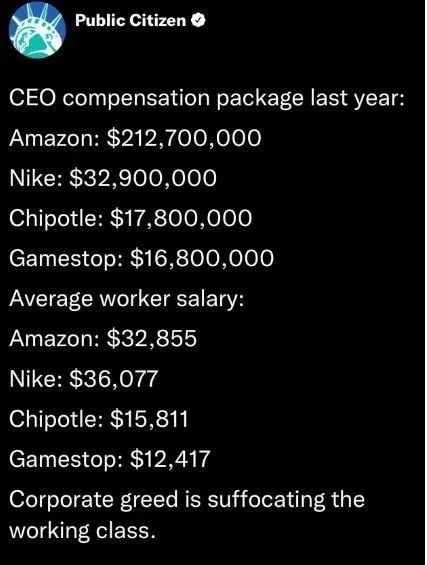
Tom Knighton explained why the above CEO Salaries are in line even though they are disproportionately higher than the average employee. It has, you guessed it, something to do with capitalism.
First, Knighton rightly points out that the excess money that these CEOs makes, if confiscated from the CEO’s and divided among the average employee, wouldn’t make a difference in a lower paid employees paycheck. Well, yeah, one executive’s salary wouldn’t make much of a difference but what about the other executives’ compensation. Most companies have VP and executive VPs coming out the ying yang who are also grossly overpaid. Throw those salaries in and I imagine you would have a much bigger kitty to distribute.
Then CEO’s have a responsible position. If they make mistakes, they could endanger other people’s jobs. Spare me. If CEOs are doing their job right, they could be eliminating jobs, so it doesn’t much matter much to the average employee. Let’s face it the average employee’s job is always under threat whether it be automation, elimination or outsourcing. The idea that the CEO is protecting his employees jobs is laughable, at best. If the shareholders and top executives are making money, there is little concern about the lower paid employees. Indeed, the average employee might be in more danger from a good CEO than a bad CEO. Besides the CEO has a team of executives working with him. If he makes a decision, it is being vetted by Board of Directors and other Executives, he rarely, if ever, makes an important decision alone. The risk is low of something disastrous.
Finally, and most importantly for Capitalism, Knighton believes you can find lower paid employees anywhere, it is difficult to find someone who can be a CEO. Knighton might look into the meat packing industry who are trying to find workers to operate dangerous machinery. Slaughter houses are having such a difficult time hiring people for these positions that they are breaking the law and hiring minors. They are also lobbying state legislatures to lower the age to work in these slaughter houses. As opposed to say, raising wages significantly in order to attract adults willing to risk life and limb to operate these machines. Why doesn’t the same philosophy of higher wages attracting the best people used to attract the best machine operators? If it works for CEO’s, it just might work for average employees as well.
As far as CEO pay is concerned it would be interesting to see if a lower pay was offered to smart ambitious young people who have yet to prove themselves what the results would be. What’s the worse that could happen? It’s not like the CEO would lose his life if he made a mistake, not like the teenagers working in a slaughter house. And, if they succeed, a lower wage for CEO would then bring more revenue into the business. Which is a win win right. I mean isn’t keep wages low one of the primary goals of a CEO? Why shouldn’t the CEO’s salary be included in this consideration. I am pretty sure you could find someone willing to do the job for less and I am betting that a good number of them could do a job. On the other hand, I know for a fact that slaughter houses can’t attract the right people to work in their establishments. Who, then, is more important and deserving of higher salaries?
Sorry, I still ca
 Mind Stewing, Fingers Typing