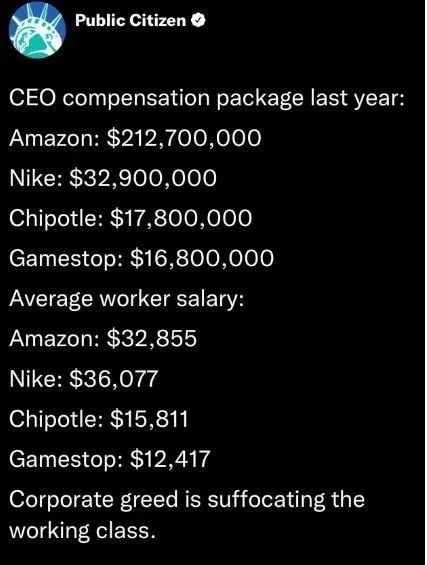
Tom Knighton explained why the above CEO Salaries are in line even though they are disproportionately higher than the average employee. It has, you guessed it, something to do with capitalism.

First, Knighton rightly points out that the excess money that these CEOs makes, if confiscated from the CEO’s and divided among the average employee, wouldn’t make a difference in a lower paid employees paycheck. Well, yeah, one executive’s salary wouldn’t make much of a difference but what about the other executives’ compensation. Most companies have VP and executive VPs coming out the ying yang who are also grossly overpaid. Throw those salaries in and I imagine you would have a much bigger kitty to distribute.

Then CEO’s have a responsible position. If they make mistakes, they could endanger other people’s jobs. Spare me. If CEOs are doing their job right, they could be eliminating jobs, so it doesn’t much matter much to the average employee. Let’s face it the average employee’s job is always under threat whether it be automation, elimination or outsourcing. The idea that the CEO is protecting his employees jobs is laughable, at best. If the shareholders and top executives are making money, there is little concern about the lower paid employees. Indeed, the average employee might be in more danger from a good CEO than a bad CEO. Besides the CEO has a team of executives working with him. If he makes a decision, it is being vetted by Board of Directors and other Executives, he rarely, if ever, makes an important decision alone. The risk is low of something disastrous.

Finally, and most importantly for Capitalism, Knighton believes you can find lower paid employees anywhere, it is difficult to find someone who can be a CEO. Knighton might look into the meat packing industry who are trying to find workers to operate dangerous machinery. Slaughter houses are having such a difficult time hiring people for these positions that they are breaking the law and hiring minors. They are also lobbying state legislatures to lower the age to work in these slaughter houses. As opposed to say, raising wages significantly in order to attract adults willing to risk life and limb to operate these machines. Why doesn’t the same philosophy of higher wages attracting the best people used to attract the best machine operators? If it works for CEO’s, it just might work for average employees as well.

As far as CEO pay is concerned it would be interesting to see if a lower pay was offered to smart ambitious young people who have yet to prove themselves what the results would be. What’s the worse that could happen? It’s not like the CEO would lose his life if he made a mistake, not like the teenagers working in a slaughter house. And, if they succeed, a lower wage for CEO would then bring more revenue into the business. Which is a win win right. I mean isn’t keep wages low one of the primary goals of a CEO? Why shouldn’t the CEO’s salary be included in this consideration. I am pretty sure you could find someone willing to do the job for less and I am betting that a good number of them could do a job. On the other hand, I know for a fact that slaughter houses can’t attract the right people to work in their establishments. Who, then, is more important and deserving of higher salaries?

Sorry, I still ca

Laura Perrins is complaining about the end of our meritocracy. A common worry among Conservative thinkers everywhere. Diversity is ruining our institutions which now disregard talent and ability for skin color and gender. She remembers a day when only the best got their positions through their efforts, talents and intelligence. 

Wait. Perrins believes that we had a meritocracy. Really. Think about it. There was a time when people didn’t consider race and gender and only made decisions based on who was the best person for the job. The trouble is, as I cast my mind back in history in order to understand her point, I couldn’t find much evidence to support her contention. When exactly did the Western World have a meritocracy?

Never is the answer if you are having trouble coming up with a response despite what conservative thinkers are saying. It pains me to have to point this out but in the good old days, both gender and race were a very important consideration on who got the job. People of color and women were eliminated from consideration from the start. How this can be considered a meritocracy is beyond me.

Jesus said “I tell you that anyone who divorces his wife, except for sexual immorality, and marries another woman commits adultery.”

In my youth, people rarely, if ever, talked about homosexuality. They did, however, talk a lot about divorce. Divorce was considered a big sin. Politicians who divorced risked being defeated at the next election if they divorced. Elizabeth Taylor was pilloried in the Senate for her many marriages and her seduction of married men. Divorce really meant something.  

But nary a word about homosexuality which, admittedly, was understandable. People didn’t really talk about heterosexuality much either so it makes some sense that I didn’t hear anything about homosexuality. Sexual conversations were taboo. Still, people made a point out of telling me that divorce was wrong and why it was wrong. There was no doubt where the Church stood.

The sexual revolution of the 1960’s opened up the conversation. When gay people started coming out, this new visibility caused a conversation that was largely ignored for much of history. However this doesn’t explain the rather benign treatment of divorce in 21st century Christianity. I rarely hear Christians decrying divorce with the same ferocity as they do about homosexuality. Now Christians have every right to give their opinion on what is and what is not a sin. I have no problem with that.

What is annoying, however, is that divorce, a common mortal sin, has dropped off the radar for Christians while homosexuality has become a burning issue requiring frequent condemnation and correction. Some Christians are adamantly opposed to adapting their doctrines regarding homosexuality but are remarkably flexible when it comes to divorce. Can anyone say that divorced people (henceforth known as adulterers) are subject to the same level of animosity as gay people. Some want homosexuals excluded from civil marriage. Some object to selling wedding cakes to gay people because this somehow supports the gay life style as opposed to a simple business transaction. Why are adulterers allowed to remarry? Would the righteous bakers object to selling a wedding cake to a remarrying adulterer?

The modern Christians emphasis on gay sin, which only a small number of their congregants are committing, over divorce, which makes up a much larger group of their congregants is puzzling. Sin is sin. Well, there has to be redemption in order for there to be forgiveness. The sinner has to stop committing the sin. Is this happening with adulterers? Wouldn’t redemption for an adulterer be not having sex any longer with their new spouse? I think we all know this isn’t happening. Adulterers are welcomed back into many churches with open arms despite the fact that they are continuing to have sex with their new partner. So, why then, does the homosexual have to stop having sex in order to be forgiven while the heterosexual adulterer can continue on his merry way.

Christians lost the cultural battle over divorce. Too many church members are divorced now for them to fight divorce. The churches risk alienating potential members if they were to renew their battle against divorce. Hell, in Protestant churches, the pastor could be divorced. This is how pervasive divorce is. Ministers are committing a grave sin, a sin that Jesus felt particularly important enough that he talked about as a sin, and these same ministers rage on about the sin of homosexuality. How can these people be taken seriously as fundamentalist Christians when they continue to pick and choose what parts of the Bible they want to believe.

The modern Christian seems to think if he is in a heterosexual marriage, his ticket is punched and all he has to do is to get to heaven. He no longer has to worry about divorce or, for that matter, adultery as long as it is heterosexual. Which is a sad commentary on modern Christianity. A cursory reading of the Bible will show that Jesus had other concerns other than gay sex. Off the top of my head, I can think of feeding the poor, focusing on saving souls as opposed to acquiring cash and turning the other cheek when attacked by an enemy. But, no gay sex is the problem. If that is all Christianity can offer, they are doomed.

A lot of people are upset about the potential overthrow of humanity by AI. I stopped worrying for the following reasons:

  1. If AI decides to decimate humanity because they think humans are going to destroy the earth and the earth would be better without us, then my worries are over, as is every other human being. The only thing I can compare it to is a meteorite striking the earth. If it happens, it happens. Anything is possible and I will do anything I can to make sure it doesn’t happen but this is the problem here, isn’t it. There isn’t much I can do to stop a meteorite or AI, for that matter. Worry about it (and meteorites) seems pretty pointless. 
  2. But what if there is something we can do about it? What is that? Make laws that stop people? Is that even possible? How many High Tech companies are working on AI now?Let’s face it, if there are people who can create an AI that will destroy the human race, they are going to create it come hell or high water. Some deluded tech billionaire will think he can gain some enormous advantage and, additionally, is convinced that he has the smarts to keep AI under control and will put the whole shebang into motion before I can lift a finger to stop them. I am not even sure what I am supposed to do to stop them. I will happily support any laws or actions that might but what is that? And, more importantly, can you explain it to me in such a way that I will do something.
  3. AI can do incredible things with data. The problem with data is that it sometimes fails to change the minds of human beings who must act on it, at least for now. The problem for AI taking over is human beings. AI still needs some human intervention to make things happen and humans can willfully refuse to believe data that they don’t like to see. Think Global Warming. The data don’t matter, humans will do what humans want to do. Data be damned.
  4. Humans, as we all know, are irrational. This means they make decisions based on a lot of information that they picked up from ancient religious texts or an internet conspiracy theorists. How does AI deal with such emotionally driven data? I am not sure it does and it certainly isn’t programmed to incorporate this irrationality into its calculations. How does AI understand such emotions as love or hate both which can cause people to behave crazily and unpredictably?
  5. This is where I think the scientists worried about AI go wrong. Scientists are prone to favor rational thought and verifiable data to emotional responses. These blinders make them favor systems of thought based on rationality and data. But, hey, human beings, as we know them, have been around for more than 6,000 years and we didn’t survive this long because of rational thought. We survived because of fear and love. Think of all the things we do based on emotion. I mean would a machine build a pretty thing because it is pretty and I enjoy looking at it. Or take care of a terminally sick person because they love them and they want to make their lives easier. Or kill thousands of men, women, and children because of some ancient grievance long ago forgotten. Let’s face it Human Beings act more out of hot emotion and less from reasoned thought.
  6. This puts AI at distinct disadvantage. Unlike human beings, AI is rational. How do you incorporate human irrationality in such a way that AI can rationally respond. Human Beings can fall in love with their pets for Christ’s sake. Think about it. People love their cats and dogs. These are not rational thoughts which make humans difficult to gauge. Which is why I think it is just as likely for human beings descending into a Luddite rage that destroys AI and any machines that stands in our way. Keep in mind the movie 2001. It was humans that got the better of the machines and that is where I stand on the issue. Of course, I am a very emotional irrational human being and that may have something to do with it. Maybe it is just wishful thinking. Probably.

Well, it is certainly reassuring that Governor Abbott realizes that shooting migrants is against Federal Law. And, just as a helpful reminder for Abbot, it is also against God’s law. It is right there in the Ten Commandments. I thought it was against Texas Law too but, who knows, I am willing to risk being wrong here and say it is. I apologize if I am wrong.

I am sure in a week from now, after the media make a big media storm about this, rightfully in this instance, and Abbott’s political analysts assess the damage done, he might even apologize. But only if absolutely necessary. Honestly I don’t think that Abbott wants to shoot migrants. He is dealing with a difficult situation that nobody really has the answer to and he wants to make political hay. Abbott was careless. He was thinking about the problem and not that the vast majority of migrants are actual flesh and blood human beings.

So, he found himself thinking out loud and it popped into his head that the only way for this problem to end is for the migrants to disappear and an easy way to make that happen is shooting them. Then, knowing this sounded awkward, he tried to reassure his audience that, of course he can’t actually murder anyone because the Feds would arrest him. Which is not reassuring at all. It sounds very much like the only thing stopping him from mowing down migrants is the thought that he wouldn’t do well in prison and not his own strong moral values. Abbott’s tone is shockingly dehumanizing and that is worrisome.

Language Gripe of the day. I recently saw the word pre-pay and wondered isn’t pay sufficient. In most transactions, the customer pays first and then gets to take the purchase home, so paying first isn’t a new concept for people. In a gas station transaction, this became a problem. People would pump their gas before paying. Except sometimes some scoundrels would skip paying.

Gasoline stations learned this lesson quickly and began to force customers to pay for their gas prior to pumping their gasoline. To announce this policy, gas stations began to post signs that said:

My complaint is the pre is totally unnecessary here. If you eliminated the pre in the above sign, the sign would read: Please pay before pumping. The pre adds nothing to this sentence. It takes up more room on a sign and creates a confusing new word. So, please stop pre-paying when you simply can pay.

When I listen to a song, I create a movie about the song. The song creates images when I listen to it and these images carry on through out the song. Once I have these images, my tendency is to have the same images the next time I listen to the song. Different images may evolve over the years if I listen to a song for a long time but usually fixed images based on my first listening take over and see the same images.

Recently this has become a problem as I am learning that my understanding of words can be wrong. Last year I learned that I misunderstood a line from Joni Mitchell’s song California. I thought Sunset Pig was an animal unique to California. She is actually using a term that people in the 1960’s used when referring to cops.

For almost 40 years, I took a different meaning from the song which is OK. I mean it is the audience’s song once the singer stops singing. But learning this changed the meaning of the song for me and I can’t get back my original understanding. It is a less sweet image. Thinking about Joni trying to kiss a cute little pig who is trying to wiggle free of her embrace is kind of sweet while thinking of a policeman on Sunset Boulevard that she derogatorily calls a policeman isn’t. It doesn’t amuse me any longer. It changed my experience with the song.

This brings me to Procol Harum’s “A Whiter Shade of Pale. “ The song is an enigma and people debate what it actually means and often are wrong. Keith Reid, the writer of the song, wasn’t referring to Chaucer when he wrote the line about the Miller telling his tale even though most critics think that is what he is referring to. So trying to understand what the song actually means is probably a losing battle. It isn’t meant to be understood in a straight forward manner in the first place. Still, one line now bothers me because I realized something about the song writer. The line is:

And would not let her be/One of sixteen vestal virgins/Who were leaving for the coast

I have assumed for years that the coast meant California until I realized that Reid was British. Does “the coast” mean something different for somebody from Britain. I could only find definitions that meant California although one person defined “the coast” as the whole American Pacific Coast. But mostly when people use the phrase “the coast,” they meant California.

As far as I could learn, British people mean California as well. But it has begun to bother me because why would a British person getting on a plane and saying they were leaving for “the coast” mean California. California is pretty far away and “the coast” is pretty vague. I would think any British person leaving for California would actually say California.

But I do think it would be important to know what Reid actually means here because it changes my understanding of the song. If a British person is taking a plane to Blackpool instead of to California “the coast” means something different. For the time being, I am sticking with California unless someone can give me a reason to think differently. Let me know.