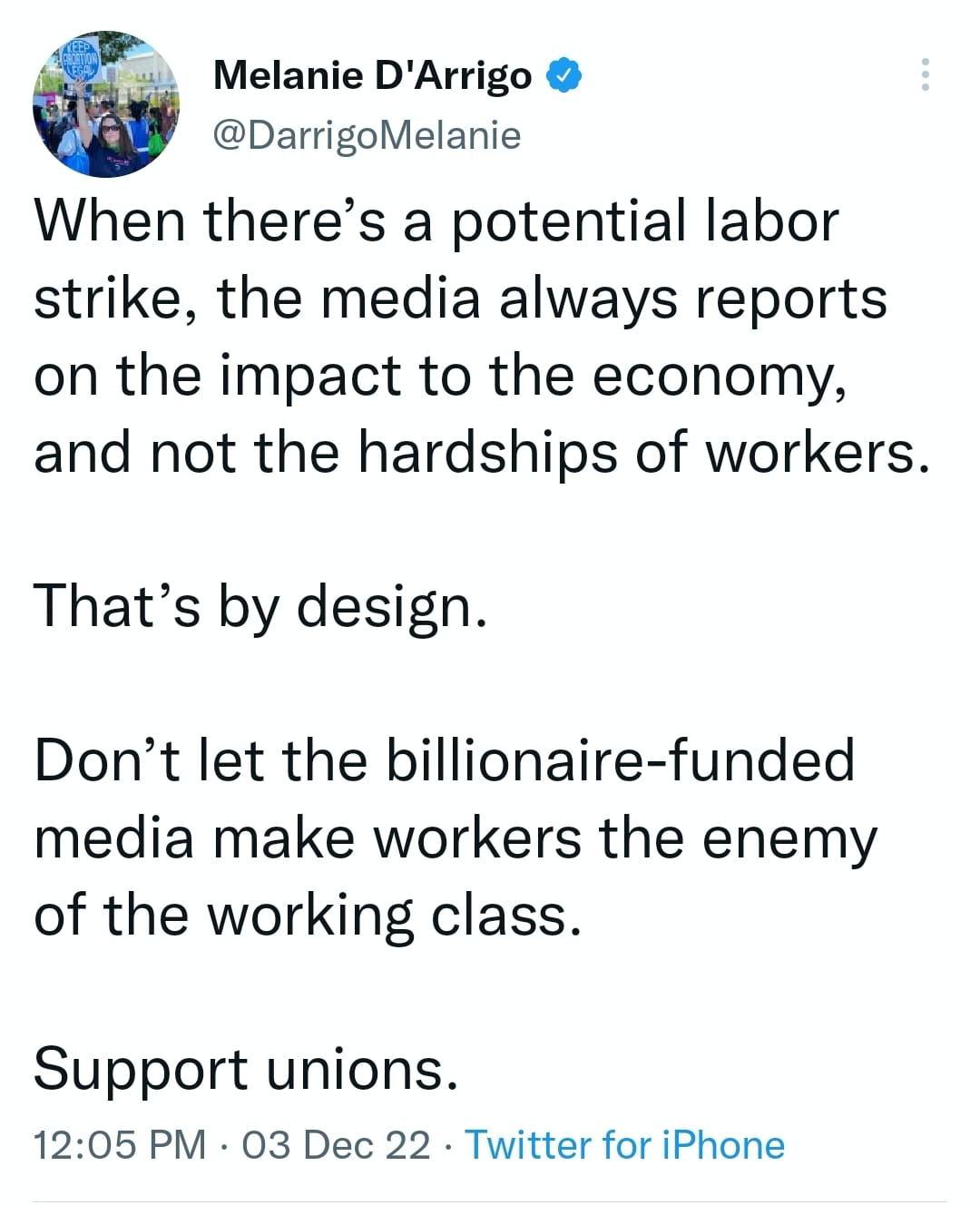
I saw the above statement on Facebook the other day. I am assuming that this tweet is in regards to the Congress’ recent rolling over of the Railroad Unions in regards to sick days. I agree with the writer of this tweet that some of this antipathy towards workers in general and unions in particular is created by the business owned press. Still, there is something in the American psyche that supports this tendency. If it is a choice between helping individual people or helping business, Americans will support business.
Sick days, which in every other Western country is a given, are not mandatory in the USA. Some businesses offer them, some business don’t. More and more businesses are going to a time off option — the employee is given so many days off in a year. Which really means that the employee has to take sick days from his vacation days. (Imagine a person from HR here. She says something like you can take these days for your trip to Europe or if you have a nasty flu. It’s all up to you. Isn’t it fabulous all the freedom that the company is giving you). Business believe that sick days are unaffordable luxury and will drive them out of business even though every other Western country require sick days and continue to operate successfully after making them legally mandatory. People get sick. People also need paycheck. If an employee doesn’t get sick days, this creates a problem for them. Their choice is come into work sick or stay home and lose pay.
Both options are bad ones. They force workers to choose between their income and their health. Yet, despite the world’s recent experience with COVID, mandatory sick days for employees still is not required in the USA. Why? Fear mostly.
The big fear is the reaction of business. Fear that business will resist the better treatment of workers. If the company declines to negotiate and then the employees strike, the burden of the strike falls on the workers. Labor will be blamed for any economic consequences related to the strike. All the talking heads spouting off about the Railroad workers were worried about the economy and what a disaster a strike would be for the country. The consensus was that the Government should do whatever it takes to prevent a strike. Somehow missing from these discussions was that the railroad workers still don’t have any sick days and are left with a difficult decision every time they are sick. Workers reasonable demands can be ignored if the economy is at stake. But, of course, the economy is always at stake.
Americans have a curious attitude toward business. The big idea is that cities and states should do everything possible to keep businesses located in their jurisdictions and labor should be damned happy to have them. Businesses provide jobs. These localities give all kind of inducements to business – tax breaks, cheap land, paying for the workers to be trained, all kinds of tangible benefits to keep businesses from leaving. The government thinks that once they have secured the business through these inducements that they have won the loyalty of the business. The business, on the other hand, views this as a temporary measure and is always pressing for better inducements with the threat of leaving always hanging over the localities.
But if workers ask for better treatment, Americans think why are these people screwing with business. Who knows what the business will do now that intransigent workers are making financial demands? Business will remind the localities that businesses can operate anywhere and can relocate operations to a cheaper and more pliant labor force if workers don’t quit their griping. If labor isn’t careful, businesses can also automate more of their work which will eliminate more jobs. Is that what the workers want? The picture is always framed that the business are just trying to make money while the employees are making unreasonable demands that can drive the business out of the community.
The mere idea of an employee asking for better treatment is a bad look. Most Americans work for non-union shops so are used to businesses telling them what their raises are, what the health benefits are and how many sick days they have. There is no negotiation between two sides. It is one side telling the other side what they will get. To the American mind, this is the way labor relations are handled. Any time workers make demands, the American public gets the vapors because how dare workers challenge businesses with their own ideas of what they should received in wages and benefits. This is for the business to decide. What will business think of our community if these workers keep making demands?
Thus government and labor think that they are making every possible concession to keep businesses in the community least the government get blamed for driving businesses out and causing unemployment. This places communities in impossible position of giving more and more to keep businesses happy and getting less and less in return from the businesses. Despite all those terrible demands from labor, the railroads are the most profitable business in the USA. But, of course, paid sick leave would drive them out of business.
 Mind Stewing, Fingers Typing
I understand it from both sides. Healthy workers were complaining they should be entitled to the same time off as sick workers. Why they didn’t just take the time for mental health days is a question only they can answer. The result was business saying fine-we’ll average the time our healthy and sick workers are out, add that to vacation time, and give everyone a lump sum PTO-which was less than sick workers were out but more than healthy workers were out.
But business did not take into account the ramifications: namely that sick workers would now come in and infect healthy workers. Everybody may be working but at lower capacity. Business also did not foresee the covid era when world pandemics lead to workers actually dying or quitting over mandates to come into the office.
The short-term solution was additional sick time specifically for covid-related illness, either covid itself or reaction to the covid vaccines. But 3 years in, this short-term solution needs to become permanent. It’s time for business to rethink sick time and allot it separate to vacation. Americans already get fewer vacation than other industrialized nations, and the reality is many Americans work during their time off anyway.
Count me among them. I regularly work Sunday nights, so I can organize my inbox, prioritize Monday’s work and generally keep the level of Monday stress to a more manageable level. Those 1-2 hours are worth it to me for how I will feel during Monday’s 8+ hours. I also check in during at home vacations/holidays. Why? Because again, it helps to minimize the stress on my return.
There’s not much point to vacation if I’m so stressed out about what’s waiting for me that I can’t relax, or if the relaxation achieved from time off is not only wiped out on my return but makes me more stressed than I was before taking vacation.
Shouldn’t my workload be more reasonable? Sure. But from a business perspective, it doesn’t make sense to hire another person until the business generates the work of 2 people. The problem comes when someone leaves, and the open position means a person is now doing the work of 2 people plus the additional .8 workload each person may have been doing. Now one person is doing the load of 3.6 and that’s untenable. For an 8-hour day, that’s more than 24 hours of work. I contend that businesses need floaters to handle non-specialized tasks to help ease the burden for open positions and sick workers-and which can be training grounds for later promotion into more specialized roles…but what do I know? Only the 3.6 jobs I’m now doing.