When I was a kid, say 11 or 12, it annoyed me to hear old people (think grandmother here and not mother) always talking about how they won’t be here next year. It didn’t occur to me then that these people actually died. It seemed liked an unlikely subject to dwell on because, chances were, they would return next year. Why were they jabbering on about and making me feel bad about them potentially dying?

Then I turned 65, and I began to understand the feeling but I am having a terrible time putting it into words. I now see an end where I never saw one before. From about the age of 21 until I turned 55, I ran. It was a part of my life. It kept me in shape. And without thinking about it I stopped running. At first, it was due to an injury. I have a trick ankle and it was constantly giving out on me. Well, it gave out on me while running and I got hurt. Nothing major a lot of scrapes and bruises but I had to stop running for awhile. Except I got better and I didn’t resume running.

The truth was I was tired of running. I just didn’t enjoy it anymore. I was tired of scraped knees and twisted ankles. I was tired of dodging cars and bicycles. I was tired of making time for running in my busy day because I had a reached a point where my body required more running to achieve the same results. Now, I am sure there are runners out there saying, this is nothing, you can still run, I just need to adapt my runs to my aging body. I am sure they are right, I am just not interested anymore. Even though I made no conscious decision to quit, I know I will never run again.

This is what aging is about. There are a lot of ends coming my way. This is not something I saw when I was younger. I see it all the time now. My partner and I bought a car last year and he said this is probably the last car we will ever buy. Given that I hold onto cars for 15 years at a minimum, I thought, shit, he is right. This leads to another new way of thinking, even if I do make it to 80 — would I buy I new car? Why would I make the investment? Will I be able to pass California’s driver test? So even if wanted to buy a new car in 15 years would it make any sense given an even more restricted time line on my eventual death.

I want to come up with a word that describes my feelings here. It isn’t quite sadness even though sadness is a part of it and it isn’t quite fear although there is an element of that too. The best that I can come up with is I am beginning to see a future where I am not in it. It shocks me. I know that this sounds self-centered. I don’t mean it that way. Rationally, I know that I am not the center of the universe, the world will continue quite nicely without me. I am, however, the center of my world. I have spent the last 65 years seeing my place in this world. Year after year of working, getting an education, traveling to distant lands, reading books, seeing movies, flirting, running, fucking and all the many other wonderful things I filled my time with. I no longer will be here for the fun. It is disconcerting.

For some reason, it is quite easy to see myself in the past. I had parents and grand parents. I can see my place smack dab into the middle of a family tree. I am quite clear on where I came from but where am I going? Nowhere, it seems. No one will get to meet me. My opinions will no longer be heard. My presence isn’t required for the world to continue merrily on. Why would the world do that?

The changes in store for me are mostly ends. I will stop climbing the steps to the top of my apartment because I can no longer manage them. I will need to get rid of my worldly goods because they will no longer fit into the much smaller space I am sure that I am destined for. I will stop driving. I will get rid of my work clothes because I no longer wear them. I will travel less because it is too much of a hassle to get through airport security and eventually I will stop altogether.

This sounds rather depressing but that isn’t exactly what I am feeling. I am presently in good health and I know, if everything goes right, I have a good 20 years are so to enjoy. Yet, I continue to see endings. I continue to stop doing things I can no longer do the way I used to do. I have a limited time frame and many of my coming decisions focus on how the end of my life looks like. What will I do when I when I finally get too sick to stay in my very big and unsuitable house for an old person? What do I want to do with my body? Buried or cremated? Will I have enough money to see me to the end? What if I outlive my money? This is not a future the young want to think about and they don’t want to talk about. They don’t see the end coming. Why should they? It isn’t a pressing issue for them. But, for me, these are pressing questions that I can’t really delay answering for much longer.

The pain that comes along with aging concerns me. Aging has a lot of emotional and physical pain in it. New aches and pains appear every day now. My body is less resilient than it was before. More of my time is consumed in medical tests, procedures and operations which is letting me know that body is breaking down. Friends and family are getting seriously sick now. Who will die before me? How many deaths before my heart breaks? The end has a lot of pain. There is no way around it because even the best ending comes with a lot of goodbyes. Final goodbyes are painful.

I don’t mean to be morose. Seeing the end is a weird thing. Incredibly difficult to explain. It is a mixture of sadness and disappointment and pain but the funny thing is I don’t think I have ever been as happy as I am now. Seeing the end is pretty liberating too. I am much more sensible. I do not suffer bores and by that I mean boring people, boring books, boring movies, anything boring. I used to think I had to finish everything I started. I don’t. If I am not engaged in something, why bother. Seeing the end has made me a better manager of my time. I see time is now limited. I want to use it wisely.

And I don’t want it to end. I appreciate every moment of my life now in a way that I could never have when I was younger. I know life clearly has an end. It is a strange and emotional place to be in. I wish I could describe it better because it really is something to experience.
The New York Post is complaining that people get too much money in unemployment benefits so they opt for these benefits over working an actual job. Boo Hoo. Let me try to shed a tear.

First, and most importantly, I don’t know where the Post is getting its statistics but they are both wrong and misleading. As a recent recipient of unemployment insurance, I can assure you that it is nowhere as large as the Post is stating. I received the maximum benefit for unemployment which was all of $450.00 a week which is $11,700 in a six month period. When I reached the six month limit, I was immediately cut off.

How the Post got $71,063 as the maximum benefit for the state of California is wrong. The statistics that the Post provided base there numbers on both adults in a family of four (2 adults and 2 dependent children) being unemployed. Highly unlikely but OK for the sake of argument lets go with it. Using California as a measurement this means $23,400 is the maximum benefit they would receive. The average cost of the Obamacare Health benefits for a family of 4 without subsidy is $1,403. I doubt that the government subsidized $38,000 for a benefit that only costs $1,403. The Post’s numbers just don’t add it.

Then, there is that the Obamacare subsidy is based on a person’s last year of income tax statement. When I was investigating whether to take Obamacare when I became unemployed I learned that I was ineligible for the subsidy because I worked a complete year and thus made too much money. I would become eligible for the subsidy only after I filed for income tax in the next year. By this time, I lost my unemployment benefits so coupling Unemployment and Obamacare benefits is misleading. The unemployed rarely, if ever, receive both benefits at the same time.

The Post also uses the maximum benefit as its benchmark. What the Post failed to advise its readers is that only the highest paid earners received the maximum. People who made lower salaries, received a lower level of unemployment insurance benefits. Yet, the way the Post frames their case, every unemployed person is making $71,063 (at least in California) on Unemployment Benefits and Obamacare. This sum isn’t even close to the truth. Most people aren’t receiving the maximum benefit and are not receiving it in conjunction with Obamacare subsidies.

Finally, and most damning of all, the present unemployment rate for nation is 3.7%. There isn’t a lot of unemployed people to get back into the workforce. Cutting Unemployment Benefits isn’t going to change this.

So what is a poor businessman to do? The answer, rooted in Capitalism, is he should raise wages so he can attract workers. Perhaps stay at home mothers, retirees and students might be enticed into the workforce with higher wages. Why not give it a try and see what happens? But, no, the Post would rather complain about the lazy nature of the American Worker instead of recommending that businesses adapt to the present economic situation and pay higher salaries.

Hallelujah. Although this will comes as no surprise to anyone in the corporate world, research shows that too many meetings are bad for both the employee’s state of mind and, because of that, corporate productivity. I particularly like the observation that if someone isn’t given a break from meetings that they take one anyway — it just is in the meeting. So, while the person’s body may be attending the meeting, the person’s mind is elsewhere.

All of this would seem obvious. Schools give children recesses for a reason. It is difficult to focus on a subject for terribly long and, in order to help the child’s retention, there is play break. Children come back from recess more energetic and ready to study. Somehow the work world has bought into the notion that adult human beings are somehow different from children human beings and thus can endure a day filled with meetings. They can not and the science shows this.

Multiple meetings in a work day is a relatively modern concept. When I started working in the1980’s, a day of back-to-back meetings was rare. People worked and the occasional meeting was held. Meetings were so rare that they were often accompanied with donuts or cookies. Sadly, the treats have been ditched and the meetings are innumerable and endless.

I blame computers. Now, I don’t have any proof but the more automated my company became, the more meetings the company seem to call. I am guessing this is because while human beings made mistakes with non-automated processes, the process itself very rarely changed. If mistakes were made, the employee may need retraining but the process stayed the same. With automation, on the other hand, procedures changed on a regular basis because there may be a problem with the automation. This meant that a workaround was needed to to keep the business running. People needed to talk about the workaround because one department could easily implement the change while the workaround would bring another department the brink of disaster. People understandably had to talk.

Automation brought a slew of meetings. People needed to know when the system was down and when it could be brought up. They needed to know that the system was performing certain functions incorrectly and what to do if you experienced it. They needed to know that the system was being updated and what information you needed to give your employees. Meetings and more meetings were the result.

Then teleconference came along and meetings, at least in my mind, went out of control. They became so frequent that some days I found myself in back-to-back meetings for days. I worked for a European company with a huge presence in Asia. I now began to have teleconferences at odd times – say 6AM in my morning. Last minute meetings became the bane of my existence. I could dutifully check my next day schedule for meetings before I left work each day and find a new meeting invitation on my calendar. Someone, while I was sleeping, decided to call a last minute teleconference. And I wasn’t that important of a person. The big wigs, more often than not, are behind closed doors for days on end.

I could live with this if the meetings were really necessary. But most of the time, they weren’t. There were check-ins. How are things going with this project? Fine. Do you have any questions or need my help? No. The meeting was over in 5 minutes which is really annoying after I carted my ass out of bed at 5AM in the morning. Or, worse still, I shouldn’t have been invited in the first place? I have sat through meetings in which I have sat quietly while people talked about something I knew nothing about, waiting patiently for my role to be revealed to discover that there was no reason whatsoever for me to be on this call. I once had someone claim that it was courtesy to keep me in the loop about the project. Why would anyone invite you to a meeting with no expectations that you have anything to contribute? I understood nothing that was said because I knew nothing about the project. If I was asked by anyone what the project was about, I could maybe recall the name and little else.

So, as you can see, I am happy to hear that people have begun to see the productivity issues related to too many meetings. Hopefully someone with power will take this new information seriously and tackle the proliferation of meetings. I am betting there will be a meeting coming to your Outlook calendar soon. Don’t thank me.

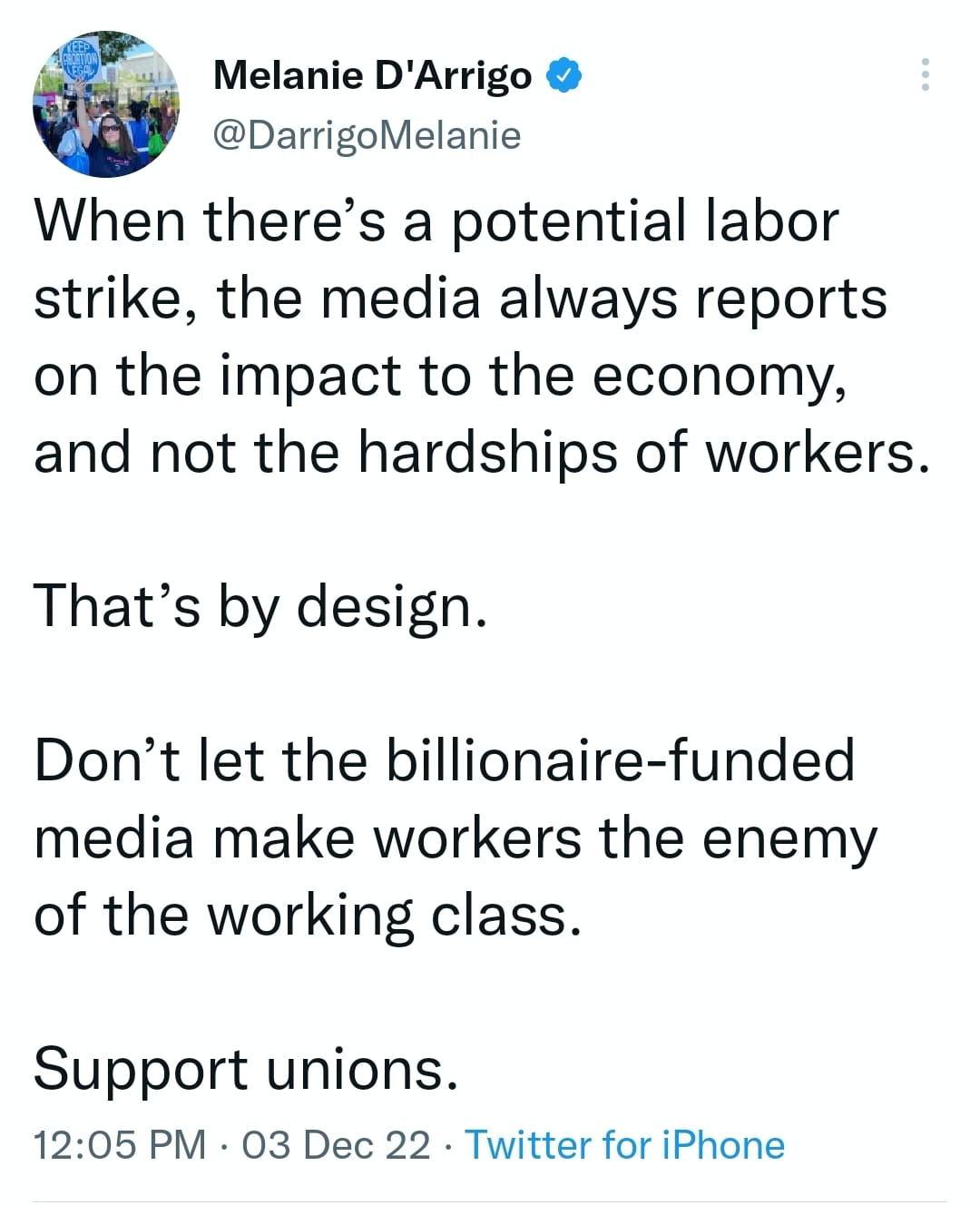
I saw the above statement on Facebook the other day. I am assuming that this tweet is in regards to the Congress’ recent rolling over of the Railroad Unions in regards to sick days. I agree with the writer of this tweet that some of this antipathy towards workers in general and unions in particular is created by the business owned press. Still, there is something in the American psyche that supports this tendency. If it is a choice between helping individual people or helping business, Americans will support business.

Sick days, which in every other Western country is a given, are not mandatory in the USA. Some businesses offer them, some business don’t. More and more businesses are going to a time off option — the employee is given so many days off in a year. Which really means that the employee has to take sick days from his vacation days. (Imagine a person from HR here. She says something like you can take these days for your trip to Europe or if you have a nasty flu. It’s all up to you. Isn’t it fabulous all the freedom that the company is giving you). Business believe that sick days are unaffordable luxury and will drive them out of business even though every other Western country require sick days and continue to operate successfully after making them legally mandatory. People get sick. People also need paycheck. If an employee doesn’t get sick days, this creates a problem for them. Their choice is come into work sick or stay home and lose pay.

Both options are bad ones. They force workers to choose between their income and their health. Yet, despite the world’s recent experience with COVID, mandatory sick days for employees still is not required in the USA. Why? Fear mostly.

The big fear is the reaction of business. Fear that business will resist the better treatment of workers. If the company declines to negotiate and then the employees strike, the burden of the strike falls on the workers. Labor will be blamed for any economic consequences related to the strike. All the talking heads spouting off about the Railroad workers were worried about the economy and what a disaster a strike would be for the country. The consensus was that the Government should do whatever it takes to prevent a strike. Somehow missing from these discussions was that the railroad workers still don’t have any sick days and are left with a difficult decision every time they are sick. Workers reasonable demands can be ignored if the economy is at stake. But, of course, the economy is always at stake.

Americans have a curious attitude toward business. The big idea is that cities and states should do everything possible to keep businesses located in their jurisdictions and labor should be damned happy to have them. Businesses provide jobs. These localities give all kind of inducements to business – tax breaks, cheap land, paying for the workers to be trained, all kinds of tangible benefits to keep businesses from leaving. The government thinks that once they have secured the business through these inducements that they have won the loyalty of the business. The business, on the other hand, views this as a temporary measure and is always pressing for better inducements with the threat of leaving always hanging over the localities.

But if workers ask for better treatment, Americans think why are these people screwing with business. Who knows what the business will do now that intransigent workers are making financial demands? Business will remind the localities that businesses can operate anywhere and can relocate operations to a cheaper and more pliant labor force if workers don’t quit their griping. If labor isn’t careful, businesses can also automate more of their work which will eliminate more jobs. Is that what the workers want? The picture is always framed that the business are just trying to make money while the employees are making unreasonable demands that can drive the business out of the community.

The mere idea of an employee asking for better treatment is a bad look. Most Americans work for non-union shops so are used to businesses telling them what their raises are, what the health benefits are and how many sick days they have. There is no negotiation between two sides. It is one side telling the other side what they will get. To the American mind, this is the way labor relations are handled. Any time workers make demands, the American public gets the vapors because how dare workers challenge businesses with their own ideas of what they should received in wages and benefits. This is for the business to decide. What will business think of our community if these workers keep making demands?

Thus government and labor think that they are making every possible concession to keep businesses in the community least the government get blamed for driving businesses out and causing unemployment. This places communities in impossible position of giving more and more to keep businesses happy and getting less and less in return from the businesses. Despite all those terrible demands from labor, the railroads are the most profitable business in the USA. But, of course, paid sick leave would drive them out of business.